
If there are no paragraph separations in this article, please double-click on the title and they will appear. 🙂
Kerrian’s Notebook has explored the world of guns and ammo in several articles, through the eyes of law enforcement officers, professionals in firearms training, as well recreational gunowners. Members of each of those groups have expressed clear opinions to me as to the serious nature of what happens when handguns and long guns are fired. So, when gun use is misrepresented on the small or large screens, lots of head-shaking occurs and outright laughter echoes across the county.
Tom Rizzo, specializing in Western fact and fiction during the 1800s, and occasional contributor to Kerrian’s Notebook, recently published an article featuring the viewpoints of famous gunfighters of the Old West. He graciously agreed to share that fascinating article with us.
“Gunmen on Gunfighting”
– Accuracy is Final –
By Guest Writer Tom Rizzo
Most Old West gunmen—law keepers and lawbreakers—would agree that accuracy trumped speed in gunfighting.
WYATT EARP
Legendary lawman Wyatt Earp, who spent several decades on the American frontier, formed strong opinions and observations about gunfighting.
Earp emphasized accuracy over speed and favored a deliberate, slow shot in a high-stress, rapid situation.
_______
BAT MASTERSON
Bat Masterson, Earp’s close friend, developed his own precise ranking of survival skills. At the top of the list was mental focus, the ability to stay cool and make split-second decisions, especially while being shot at.
Masterson also prioritized deliberation, accuracy, and speed.
_______
WILD BILL HICKOK
Wild Bill Hickok’s advice centered on the psychological and mechanical reality of combat. He also emphasized accuracy, emphasizing that a rushed shot was a fatal mistake.
“Take your time,” advised Hickok. Rushing, he said, leads to missing, “which only gives your opponent more time to aim and kill you.”
Hickok also believed in being bold, decisive, and aggressive. He was also a master of knowing the effective range of his pistols, famously killing Dave Tutt from roughly 75 yards away—a distance most gunmen wouldn’t even attempt with a revolver.
_______
JOHN WESLEY HARDIN
John Wesley Hardin, for the most part, led a more violent life than Earp, Masterson, and Hickock. He focused on preparation and technical advantages.
Above all, Hardin relied on accuracy. Witnesses often told of Hardin shooting others through the eye, in the head, or in the center of the body.
Hardin, like Hickok, also possessed an acute awareness of the range of pistol fire. Hardin preferred close-quarters gunfights to long-range exchanges.
Hardin preferred carrying multiple weapons, including famously sewing holders into his vest with the butts pointing inward for a faster “cross-draw.”
_______
Legendary lawman Wyatt Earp mocked the image of two men standing in the middle of the street, a gun in each hand, held close to their hips, “both spitting smoke together.” He described it as nothing more than “the picture of a fool, or a fake.”
He once told author Stuart N. Lake that those who saw themselves as “two-gun men” never fired both guns at the same time.
“Some men could shoot equally well with either hand and in a gunplay might alternate their fire; others exhausted the loads from the gun on the right or the left . . . then shifted the reserve weapon to the natural shooting hand . . . “
According to Earp, “such a move—the border shift—could be made faster than the eye could follow by a top-notch gun-thrower, but if the man were as good as that, the shift would seldom be required.”
Earp expressed contempt for the idea that anyone would attempt to bluff another person with a gun. “When a gunfighter reached for his forty-five, every faculty he owned was keyed to shooting as speedily and as accurately as possible, to making his first shot the last of the fight.
“He had to think of his gun solely as something with which to kill another before he himself could be killed.”
He also spoke of notches on guns. “I never knew a man who amounted to anything to notch his gun with credits, as they were called, for men he had killed,” said Earp.
“Outlaws, gunmen of the wild crew who killed for the sake of brag, followed this custom. I have worked with most of the noted peace officers … (who) have handled their weapons many times, but never knew any of them to carry a notched gun.”
(Wyatt Earp: Frontier Marshal) is available in paperback and as an audio program.)
While some people celebrated the fast draw, real Old West gunmen relied on deception, superior firepower, and a cold calculation of odds. They chose weapons based on reliability and “stopping power,” and often abandoned the revolver when things got serious.
A lawman’s weapon of choice, for the most part, was the shotgun, especially for close-range survival.
Others preferred the Winchester Model 1873, often referred to as The Gun that Won the West, because it often used the same .44-40 cartridges as a gunman’s revolver, simplifying ammunition needs.
Outlaw Jesse James favored the S&W Schofield. Its “top-break” design allowed a rider to eject all empty shells and reload much faster than a standard Colt.
_______
The key to surviving the life of a gunman often depended on not taking unnecessary risks and avoiding face-to-face confrontations. Gunfights were terrifying. Fair fights were rare. A gunman’s goal was to “get the drop” on an opponent—a concept that resulted in something akin to murder or assassination rather than a duel.
-0-
Many thanks for sharing, Tom! 🙂

“A passion for 19th century American history, Tom’s novels include elements of historical fact. His writing journey has taken him from radio and television news reporting to The Associated Press, where he worked as a correspondent, followed by several years in advertising and public relations.”
Please visit the informative and entertaining tomrizzo.com for more information about Tom, his work, and the Old West.
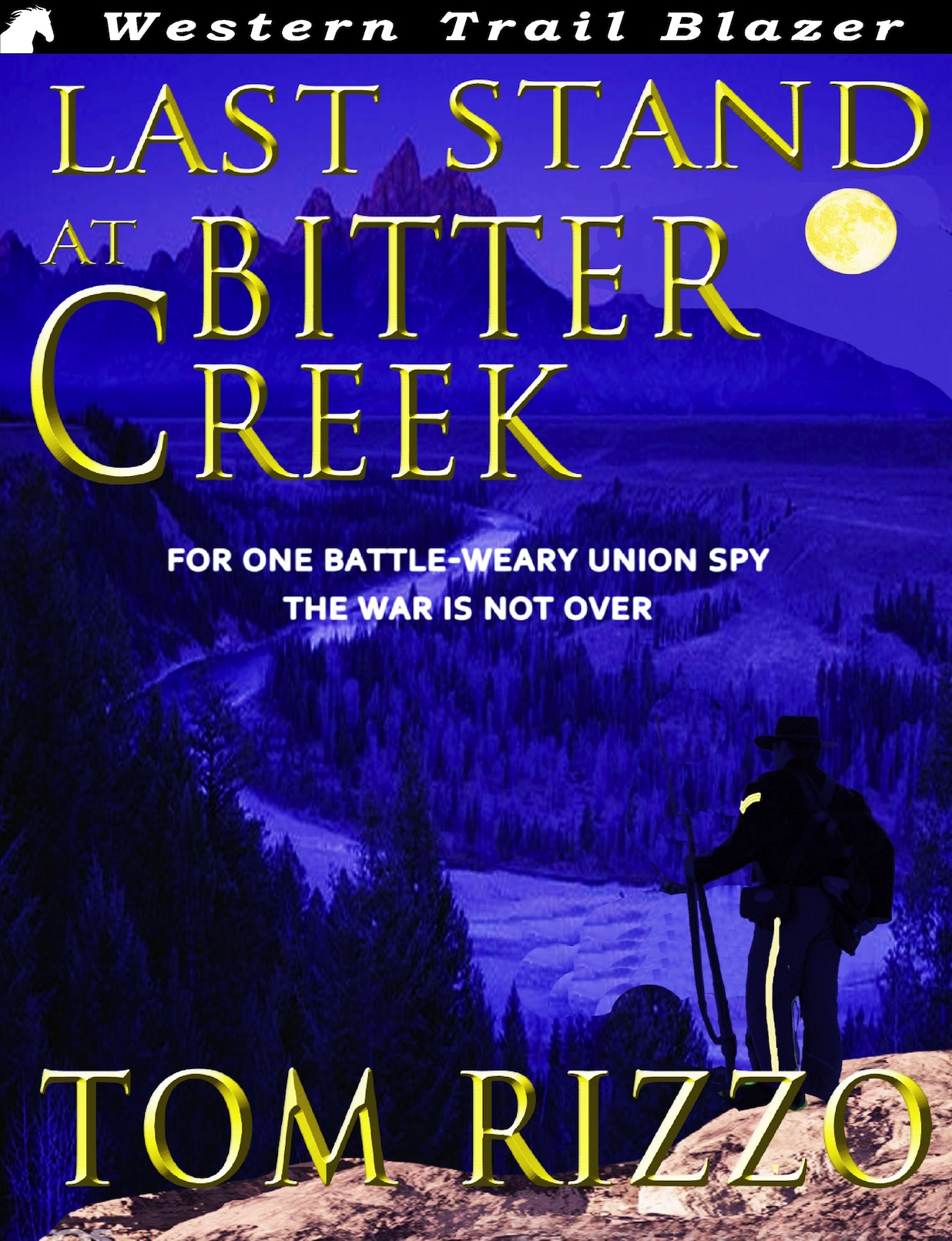
Order: “Last Stand at Bitter Creek”

