For Writers

KN, p. 287 “Postal Inspectors: Law Enforcement Agents”

If there are no paragraph separations in the article below, please double-click on the title to create a more readable version.


Most of us think of the Post Office as the local place where we mail packages, pick up our mail from those handy P.O. Boxes, and buy stamps from the helpful window clerks. In fact there are many different types of employees within the country’s postal system, including Postal Inspectors and Postal Police Officers. The 1200 Postal Inspectors are federal law enforcement officers entitled to carry firearms and make arrests in order to protect the system from people that would commit fraud through its use.


The first Postmaster General of the United States, Benjamin Franklin, set up a system back in the 1770s whereby mail theft could be investigated by the newly formed U.S. Postal Inspection Service. 240+ years later, there are 200 laws that deal with specific crimes against the USPS. These days, much more than letters and money is stolen from the mail and the postal service is used by nefarious types for transporting all kinds of illegal items, including pornography.


The USPIS reports that it made 5,759 arrests in 2019, with an 80% conviction rate, largely for mail theft and mail fraud.

While mail and package thefts are thoroughly investigated, those thefts pale in comparison monetarily to the millions of dollars of illegal drugs that criminals attempt to pass through the system each year. The USPIS employs state-of-the-art methods at their National Forensic Laboratory in Virginia to detect and identify opioids and other drugs after seizure, process fingerprints and DNA to tie the drugs to the bad guys, and ferret out cyber criminals of all types that seek to misuse the mails.

Due to the growing global problems with opioid and fentanyl trafficking, the USPIS agents work cases together with the DEA (Drug Enforcement Agency), Organized Crime Drug Enforcement Task Force, and U.S. Customs and Border Protection to enforce the laws of our country. One interesting method of detecting illicit drugs in the mail allows inspectors to check for 300+ substances without ever opening the packages.

The USPS takes the mission of guarding the mail quite seriously and has a few tips for private citizens to help avoid theft of packages and letters. Check them out:

  • Pick up your mail daily. If you’ll be away, contact the local post office and have them hold your mail until you return.
  • Don’t send cash in the mail.
  • If you need to send something important in the mail, take it to the physical post office or drop it in one of the big blue mail boxes right before pickup time.

If you expect to receive a particular piece of mail and don’t, call the local post office and/or call the sender as soon as you realize it hasn’t arrived on time.


If you suspect mail fraud, you can report it by writing to this address:

Criminal Investigations Service Center
Attn: Mail Fraud
433 W.Harrison Street, Room 3255
Chicago, Il 60699-3255


Just in case you think that the USPIS focuses on the bad guys alone, they also send out emergency response teams after natural disasters (like fires and hurricanes) in order to restart mail service.


The USPIS press kit (https://www.uspis.gov/wp-content/uploads/2021/02/uspis-press-kit-fact-sheet-2021.pdf) points out some of the agency’s duties and history.


Stay tuned for the next article about the USPIS, where I share information about high profile cases in which they have been involved.


KN, p. 287 “Postal Inspectors: Law Enforcement Agents” Read More »
KN, p. 246 “Bodies in the Wall”

If there are no paragraph separations in this article, please double-click on the title to create a more readable version.

More bodies seem to pop up on TV at Halloween than at any other time of year. Cop shows usually add a spooky element to body discovery, with ghostly noises and haunted-house sound effects. Standards & Practices (network oversight departments that determine whether certain material is appropriate for public viewing) apparently looks the other way during October when a bit more blood and gore is added to the crime scenes.


One popular plot hook is to stow bodies in a wall. In general, the fictional bodies are discovered by accident when a building is being demolished, but in a second season episode of a Canadian P.I. show, Private Eyes, “Brew the Right Thing,” a family brewery is the target of repeated sabotage. An investigation into the puzzling incidents leads to the P.I.s swinging sledgehammers into a wall constructed decades before.


Why stow the bodies inside a wall? It would seem safer for the perpetrator to remove the body from the scene of the crime and bury it elsewhere. But consider this scenario: perhaps the murder was a crime of passion and the perpetrator had not planned to ‘off’ anyone at a construction site. A confrontation got out of hand and somebody wound up dead. Not wanting to go to jail, the perpetrator seizes the opportunity right in front of him, grabs some plastic tarp, and rolls the body into it. An unfinished wall turns into a burial hideaway.


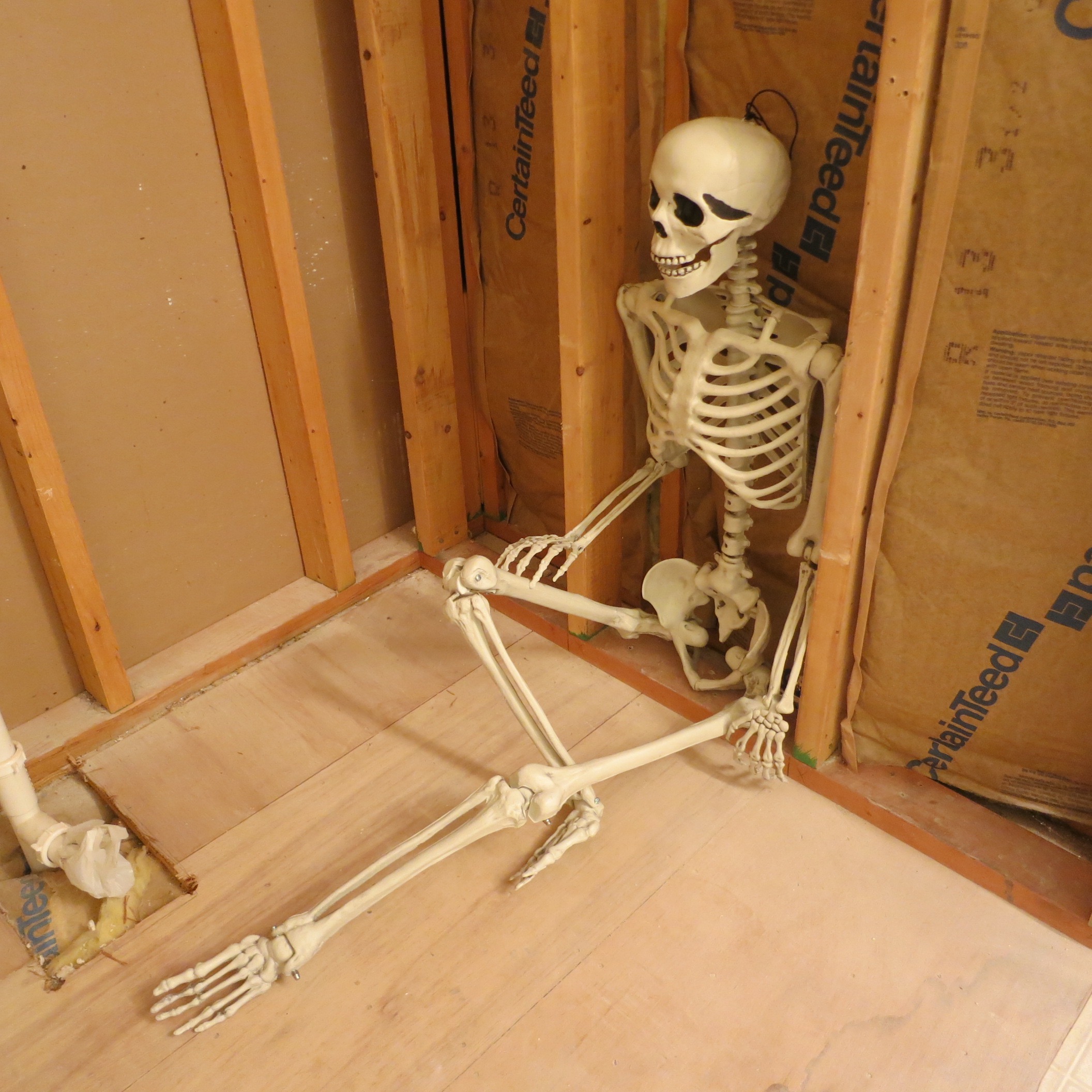
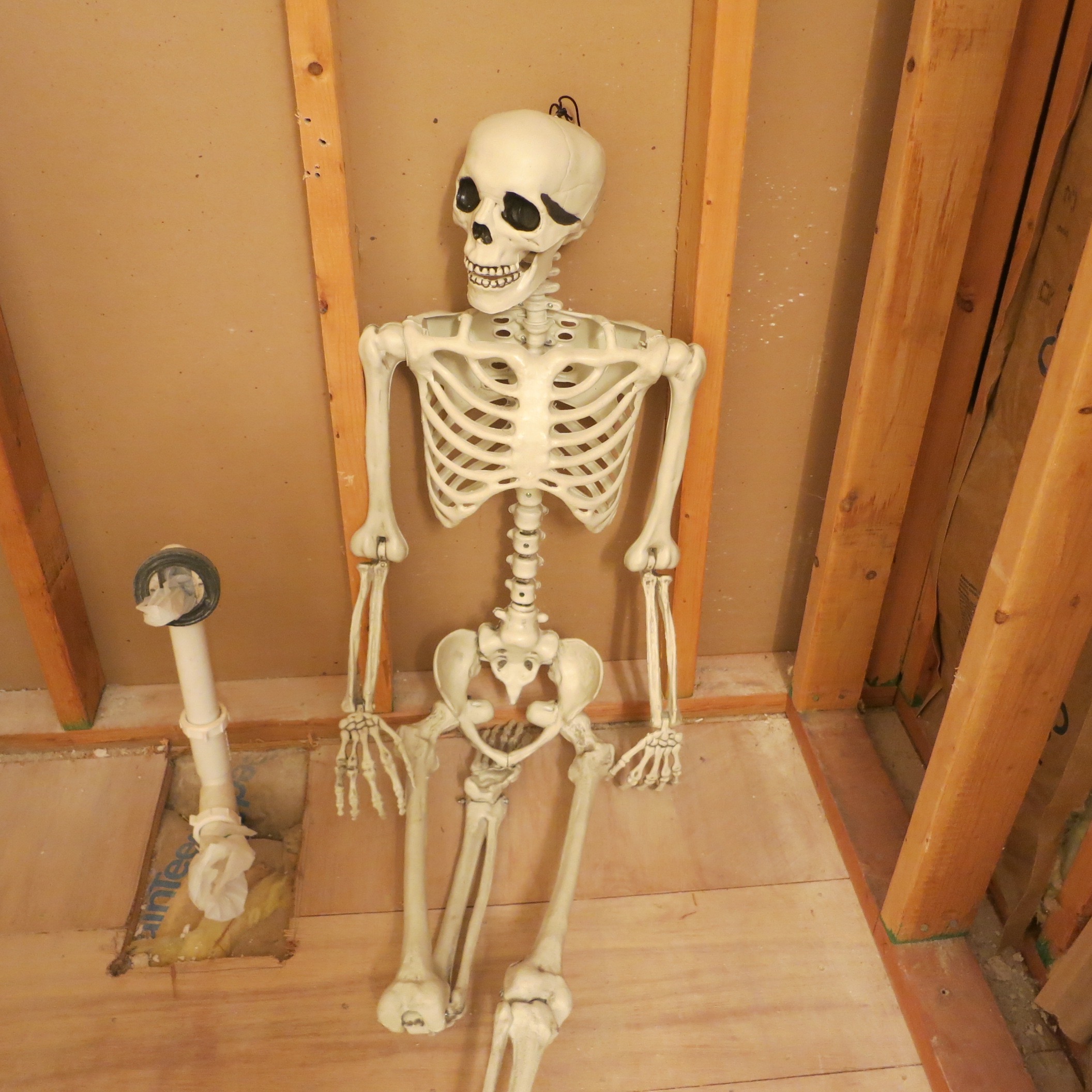
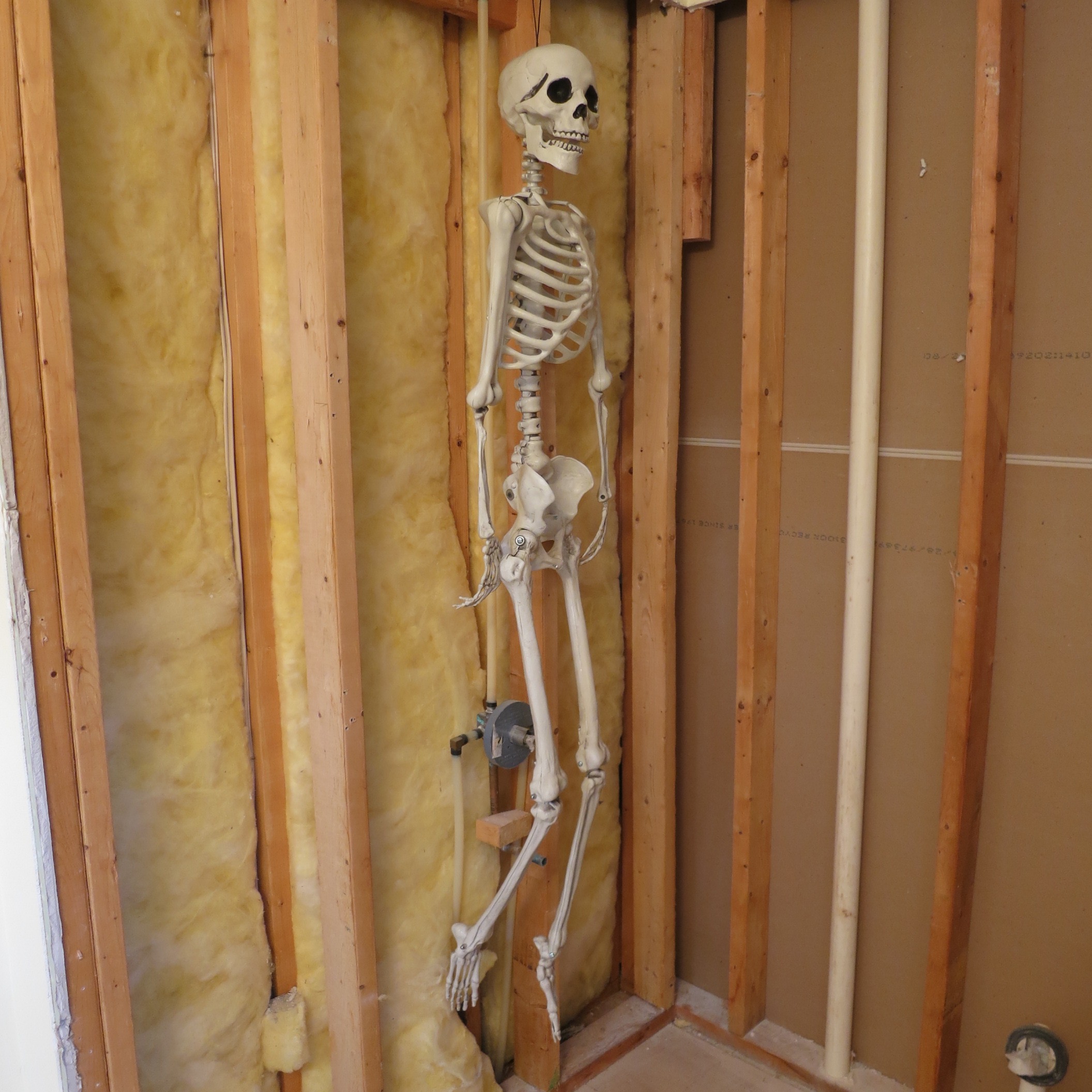
Let’s take a look at the restrictions of hiding a body at home inside a wall with the help of Kelley, our resident 5-foot skeleton. Standard two-by-four studs actually measure about 1 1/2 inches by 3 1/2 inches. Kelley is 5-6 inches thick, front to back through the sternum. Sooooo, unless the victim’s ribs have been crushed, his chest will poke out past the studs, requiring an adjustment to the hiding place.

Note: the normal distance between most studs is 16-24 inches. A big man’s shoulders wouldn’t fit straight in the narrower space, even discounting the thickness of the chest.


In a Hawaii 5-0 (modern version) 4th season episode, “Buried Secrets,” a wall is extended out into the room to create a thicker wall space that accommodates a body. More than one TV or movie crime boss has had his/her henchmen place new drywall over dead snitches, even using abandoned real estate properties as a final destination.


The assumption is that nobody will find the body once it’s in the wall. Honestly, there is really no reason to think otherwise, unless the criminals are caught in the act while mudding the drywall, or a guilty party is overcome with remorse and points a finger, or a homeowner decides to knock down a wall during a renovation.


Death in Paradise, a super popular British series, featured a disgruntled husband who buried his wife in the patio cement, after much was made of the construction site at his remote house. That cement truck raised no suspicions.

Other popular spaces to stuff a fictional TV body:

  • The bottom of an elevator shaft
  • The bottom of a dumb waiter
  • Cinder block construction
  • Foundation cement at a new construction site


Imagine the guys on This Old House discovering a body while doing a big remodel. They might start using thermal imaging devices to thoroughly inspect walls and foundations before agreeing to take on new projects. (this is not meant to imply that there ever was a body found on a This Old House site)


Has your favorite mystery/crime show featured a body-in-the-wall plot?

Please enjoy a safe, Happy Halloween! 


Photos: by Patti Phillips


KN, p. 246 “Bodies in the Wall” Read More »

KN, p. 153 “Where are the bodies buried?”

If there are no paragraph separations in this post, please double-click on the title to create a more readable version.

WShovelsIMG_2120 copy-2

I was thumbing through the Kerrian’s Notebook file cabinet, checking for the articles written about bodies – where and how to hide them and various problems with methods used on TV and in the movies. I was a Homicide Detective for a good many years and saw my share of cases that made my jaw drop. I can’t go into detail about my own cases, but the links to real world cases within the Kerrian’s Notebook articles are authentic. Stranger than fiction? Perhaps. But then, criminals often defy logic.


Take a look at ten of the most frequently read posts about how people wind up dead, and where some criminals attempt to hide the bodies. (Click on the titles)

100 ways to die an unnatural death”  

Death by Elevator”   

50 more ways to die an unnatural death”   

Cemetery at the Golf Course

Underwater Evidence and Body Recovery: Lakes and Bodies of Water

Is that a body in the rug?

Crime Scene at the Beach”  

What does a Texas Ranger do?”  

Is that a body under the deck?” 

Murder in the Cathedral”  


Keep checking back at Kerrian’s Notebook for more places to hide the bodies – you know there will be more. 😉


KN, p. 153 “Where are the bodies buried?” Read More »

Scroll to Top