
crime

KN, p. 178 “Is the builder dead yet?”

“What? Is somebody trying to kill the builder?” you ask.

They’ might be thinking about it. As in, more than one person is annoyed.
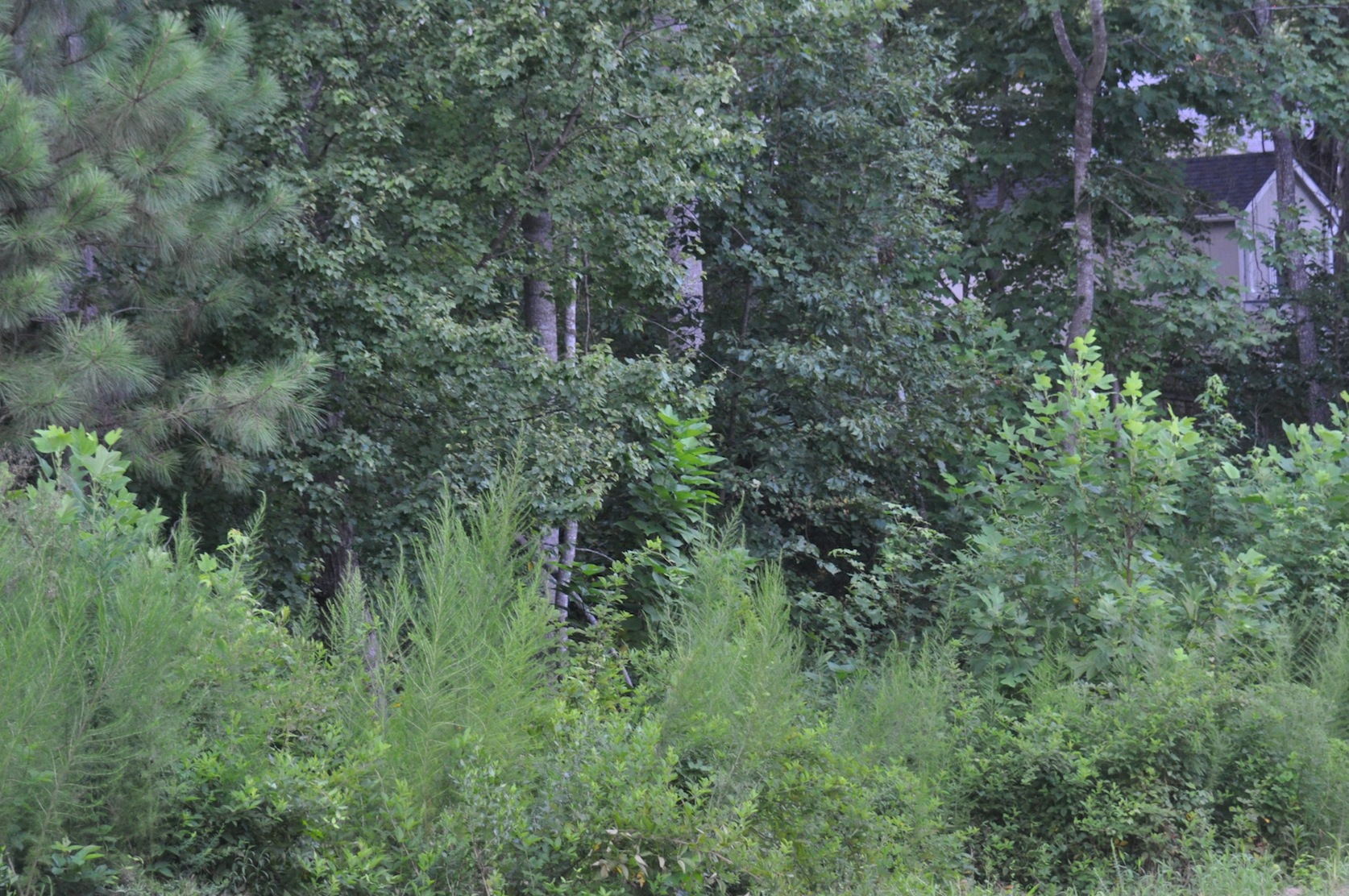
EmptyLotTreesDSC_1481

Here’s what is happening. When we moved in, the neighborhood was full of wooded lots. Even the properties with houses already there, had plenty of trees at the edges, along the fences, or next to the houses. Some were mature trees that had been left on the otherwise cleared lots before construction had begun. Property owners added flowering trees as time passed. Wildlife flourishes in this residential neighborhood of 1/4 and 1/3 acre lots. We’re not out in the country, but these are not zero-lot homes either.


Phases 1 and 2 of the larger housing development have long been completed. Phase 3 was finished three years ago, the original trees are beautiful, and the owners are adding new fruit/flowering trees each year.

Enter Phase 4. The original developer had a few lots left and found a builder to buy them. That builder wanted the lots cleared before finalizing the deal. That’s when we, the neighbors, discovered that some of the grassy/lightly-wooded areas between existing homes were actually unsold lots.

 

EmptyLotBulldozerDSC_1474

ALL of the trees from those lots are being cleared, lots of red dirt remains, and now mudslides into neighboring backyards are expected with the next heavy rain.

The developer in charge of the work told me on the phone that the lots are not wide enough to have left the trees in place. The one in the photos is 60 feet wide. Years ago, I lived in a house surrounded by maples and evergreens. That lot was 50×100. IMO, this guy simply did not want to take the time to leave a couple of trees to shade the house and protect the wildlife on the lot.

The neighbors to the left and right of the bulldozer photo were concerned enough to have the City Inspector come out to assess the situation. Note the dirt to the left appears to be in a pile that crosses the property line and would be the most likely to slide into the neighbor’s yard in the rain.

 

EmptyLotSandFenceDSC_1503

The builder’s solution was to place sand barrier ‘fencing’ on the property line. The bulldozer operator moved the dirt up against it.

Other lots have similar problems with soil grading and tree removal.

Heated conversations have been held. The neighborhood grapevine is operating at peak efficiency. Town council meetings are scheduled on the topic.

In case you doubt that neighbors and builders would actually get angry over something like this, read on.

Existing homeowners in Colorado were upset with new builders in the neighborhood who appeared to be putting in homes that did not conform to the look of the development, thereby lowering everyone’s property values. Building was delayed while plans were reviewed. Board members who were in charge of approving the designs (but didn’t) were removed from their positions and new people replaced them.


http://www.reporterherald.com/ci_20492538/homeowners-builder-bank-at-odds-lovelands-taft-farms

When developers with big money at stake and disgruntled homeowners with possible deflated property values are at odds, tempers can flare, injunctions can occur, and nothing good happens. If the builder complies with city ordinances, there is little recourse for the neighbors who don’t care for the look of the newer houses, or how the new homes will affect them.

City codes exist for a reason. Check yours out. You might be surprised at what is NOT included in some communities, such as: building setbacks, curbing pets, rules about garbage, home swimming pool regulations, livestock allowed in the city limits, etc.

We haven’t seen any bodies in the remaining woods yet, but it is still early in the process. Kidding. Tempers are high, but so far, everybody is at the yelling stage. Let’s hope that reason prevails and the builder corrects the problems he has created, and doesn’t produce any new ones.


2021 Update:

The two houses built on the properties in the photos have flooding issues. One has a perpetual pond in the backyard from the water cascading down the slope, requiring special drains to keep the water away from the house. The builder was within city code requirements and took no responsibility for the flooding caused by his bulldozing method. Buyer beware.


*Photos by Patti Phillips


Save

Save

Save

Save

Save

KN, p. 178 “Is the builder dead yet?” Read More »

KN, p. 225 “Is that poison in your tea?”

If there are no paragraph separations in this article, please double-click on the title to create a more readable version.

Our local TV station provider has one channel dedicated to movies from the late 1940s, 50s and 60s – mostly westerns and mysteries. Last week, a screening of “Arsenic and Old Lace” was in the listing, so we grabbed some snacks and settled in for an evening of murder most nefarious, with a side of laughter.

After discovering a body in his aunts’ house, the sweet little old ladies reveal to their nephew (played by the horrified Cary Grant) that they had spiked their dead guest’s elderberry wine with arsenic, strychnine, and a “just a pinch of cyanide.” And there are more bodies in the cellar.

“Arsenic and Old Lace” was a hit on Broadway in the early 1940s before making it to the big screen, where it became a success as well.

There are several other popular movies that have featured poison as a method of dispatching the victims, but instead of the tried and true ASC (arsenic, strychnine, and cyanide) combo, employ poisonous mushrooms. The victims eat their way to nausea, gastric distress, and death, instead of drinking a ‘lovely’ cup of ‘tea.’

1971’s “The Beguiled” (remake 2017): Confederate soldier takes refuge at a girl’s school, but when he betrays two of the women, he is fed toxic mushrooms.

2017’s “Phantom Thread”: dress designer falls in love with the wrong woman. She makes him toxic mushroom tea, nurses him back to health, and when he doesn’t do what she expects, cooks him a mushroom infused meal. He remains sick enough for her to control him.  

Important dating rule to remember: if your girlfriend cooks for you, always treat her well.

Mushroom poisoning symptoms range from the less severe upset stomach to renal failure and death, which may take days. It all depends on which mushroom is chosen for the deed. Agatha Christie had her favorite chemical poisons in her books and selected them according to whether or not the poison was readily available to the criminal and how much time was needed for the bad guy to get away. Read “What poisons were in Agatha Christie’s books?” here.

All poisonous mushrooms cause vomiting and abdominal pain. Testing and experience has shown that mushrooms causing symptoms within two hours are less dangerous than those that cause symptoms after six hours.

Other movies with poisons in the forefront:

In 1949’s “D.O.A.” (remake 1988): a man, lethally poisoned, rushes around trying to find out who poisoned him and why.


“The Young Poisoner’s Handbook” (1995) was based on a real case. TheTeacup Murderer kills two of his co-workers by poisoning their tea with thallium, a highly toxic ingredient used at the camera factory where he works. He continues to select and at least sicken targeted people until new cups are put in place, confusing his plan.

I mentioned “White Oleander,” a movie from 2002, in Kerrian’s Notebook, Volume 2: Fun, Facts and a Few Dead Bodies. Oleanders grow all over the southern United States, so it’s a really good idea to stay on great terms with that neighbor with the oleander hedges. Don’t bug her about returning the weed whacker. Seriously.


Photo credits: taken by Patti Phillips in Cameron, NC.


KN, p. 225 “Is that poison in your tea?” Read More »

KN, p. 169 “WitSec and the US Marshal Service”

If there are no paragraph separations in this article, please double-click on the title to create a more readable version.

USMarshalSeal-300

The Witness Security Program (WitSec), was started by US Marshal, Gerald Shur, in the late 60s as a way to get witnesses to testify against high-ranking mobsters and still stay alive. While controversial at the outset, there were enough resulting convictions by 1970 to convince government officials to put money into a formal program to help get dangerous criminals off the streets and disrupt their criminal ventures. As WitSec evolved, the safety of family members became part of the package as well.

Why get protection?

In general:

  • The kinds of cases that would need to have witness protection attached are those where the defendants are so dangerous that the lives of the witness and his/her family would definitely be in jeopardy if testimony were even considered.
  • The prosecutor is fairly certain that a conviction cannot be guaranteed unless the particular witness testifies.
  • The witness(es) may have seen a murder or other criminal activity and be reluctant to testify against the suspect unless they can be guaranteed protection.
  • Before WitSec came along, “finks’ or ‘rats’ would wind up dismembered and very dead, in retribution for speaking up against powerful mob bosses.
  • More than 80% of the witnesses have been criminals themselves, and are testifying in order to stay alive or to get back at a boss they no longer trust/like.
  • Some of the witnesses have been ordinary citizens that just happened to be in the wrong place at the wrong time, and saw something horrific. The criminal knows he/she has been spotted and WitSec is the only protection the witness has.


What happens to the witness and the family?

Once the witness has agreed to testify, he/she and the family might be placed in the custody of the Marshal service until the trial comes up – sometimes many months – but this may be the only way to keep the witness alive until the court date.

For high profile cases, the U.S. Marshal Service handles 24 hour protection right up until the testimony, then provides new identities and moves everyone involved to an undisclosed location. This location is known only by a handful of government people. If the location is compromised for whatever reason, the US Marshals will find a new location for the family and begin the process again with new identities and jobs.

Once in the new location, average housing is provided, along with job prospects. The monthly stipends continue until the family can support themselves, usually only a few months. Early in the program, there were few monetary limits which led to abuses of the program by seasoned criminals, but that has changed.

Over 19,000 people have been relocated since WitSec began.

Some have left the program voluntarily, finding it too restrictive, and some of those people lost their lives as a result. It’s not a bad deal for some, because they get a truly fresh start away from a bad neighborhood, but for most, it is a drastic change.

It is possible to get kicked out of the program and it has happened. Returning to a life of crime is cause to get booted out, but the rate of recidivism while in WitSec is less than half that of the rest of the formerly incarcerated population. Less than half.

Interesting note: for criminals that testify and are in jail (or about to go there) when they testify, there is a parallel prison system. If they went into the general population, it would be easy to find them and they wouldn’t last long.

A few States (California, Illinois, New York, and Texas) have Witness Protection Systems of their own, but the protections and benefits are limited and less broad in scope.

Nobody who has followed the federal WitSec guidelines has been killed while under the protection, but it’s not easy to walk away from extended family and friends in the middle of the night, never, ever to see them again. Cell phones with the old names and contacts are gone, losing social media is a problem for some, new identities may mean that new careers must be chosen. A familiar lifestyle must be abandoned.

If given a suitcase and told to pack in 20 minutes, what would you take? What could you leave behind?

Additional information can be found at:

http://priceonomics.com/what-happens-when-you-enter-the-witness-protection/ 

www.usmarshals.gov


Photo credit: US Marshal Service


Save

KN, p. 169 “WitSec and the US Marshal Service” Read More »

Scroll to Top