For Writers

KN, p. 200 “200 Ways to Die an Unnatural Death”

If there are no paragraph separations in this article, please double-click on the title to create a more readable version.

Thanks to the readers around the world, we have reached another milestone. This is page # 200 for Kerrian’s Notebook.  🙂  Hear Hammett barking? And the shovels clanking?

When Kerrian’s Notebook came into being, Charlie and Sheila Kerrian never expected to be around for 200 pages, not counting the additional posts devoted to our famous (or is that infamous?) Visiting Detectives. That’s a ton of cases, a ton of fun, facts, and a few dead bodies.

In honor of that milestone, we have come up with a few more ways to die an unnatural death, bringing the total on our deadly lists to a lethal 200.


Unnatural death is a category used by coroners and Medical Examiners for classifying human deaths that can’t really be described as death by natural causes. It might cover events such as accidents, homicide, clueless behavior, being attacked by wildlife, or even war.

Keep in mind that law enforcement personnel only investigate these deaths if foul play is suspected. Criminal intent is not always apparent, and autopsies are only conducted when suspicious circumstances surround the corpse’s demise.

Many thanks to all of you that contributed to our earlier lists. It wouldn’t have been as much fun without your (sometimes nefarious) methods of offing some unlucky souls.  🙂


Take a look:

100 ways to die an unnatural death


50 more ways to die an unnatural death


30 more ways to die an unnatural death
 

and now… 20 more ways to die an unnatural death.


  1. Broken neck – pitching over the handlebars of a bicycle without a helmet on
  2. Broken neck – diving into the shallow end of a pool
  3. Death by handheld fireworks
  4. Electrocution while storm chasing in a paraglider
  5. Death by coyote while hiking
  6. Death by spotted eagle ray – it leapt out of the water & struck a woman in a boat in the face. She fell and struck her head on the boat. The ray died as well.
  7. Crushed by a dumpster
    1. Death by a rolling bale of hay


    1. Impaled by the horn on a statue of a bull


    1. Death by flying manhole cover


    1. Death by colliding with fire hydrant and drowning


    1. Death on a golf cart – woman fell on the broken glass from the wine glasses she had been holding


    1. Death by selfie – maybe that should be: death by standing too close to the edge


    1. Death by asphyxiation while hiding in a cupboard


    1. Drowning – in a vat of wine


    1. Drowning – in a cat’s water bowl


    1. Water hammer explosion


    1. Death by prop gun on a movie set


    1. Smothered by clothing and gifts tossed from balconies onto the person onstage.


    1. Death by extreme sports – B.A.S.E. jumping with a parachute from fixed points (Buildings, Antennas, Spans (bridges), the Earth (top of cliff))


    All true, folks, but #194?  Maybe that explains all the Hallmark TV episodes where the good guys are hiding in closets with LOTS of air holes.


    The real question: Do you have friends that will help carry the shovels and pitchforks?  😉


    If you are a writer and have used any of the ‘200 ways’ in your work, let us know in the comments and you can plug your book here.   🙂


    *Photos by Patti Phillips, but nothing dastardly happened while she took them and no bodies were left behind. Promise.


    *Kerrian’s Notebook, and all of its content, is intended for entertainment purposes only.



Save

Save

Save

Save

Save

Save

Save

Save

Save

Save

Save

KN, p. 200 “200 Ways to Die an Unnatural Death” Read More »

KN, p. 199 “Krav Maga, Self-defense for the Real World”

If this article has no paragraph separations, please double-click on the title to create a more readable version.

One of our Texas friends could write a manual on how to live life to the max. She is whip smart, stays in top shape, participates in some extreme adventures, is a fabulous cook, and enjoys the great outdoors in all its glory.  She’s not a big fan of gyms with weights and machines and would rather keep herself in condition by participating in activities with a physical endurance component – like frigid overnights on a mountain after trekking a few miles over challenging terrain to get there.

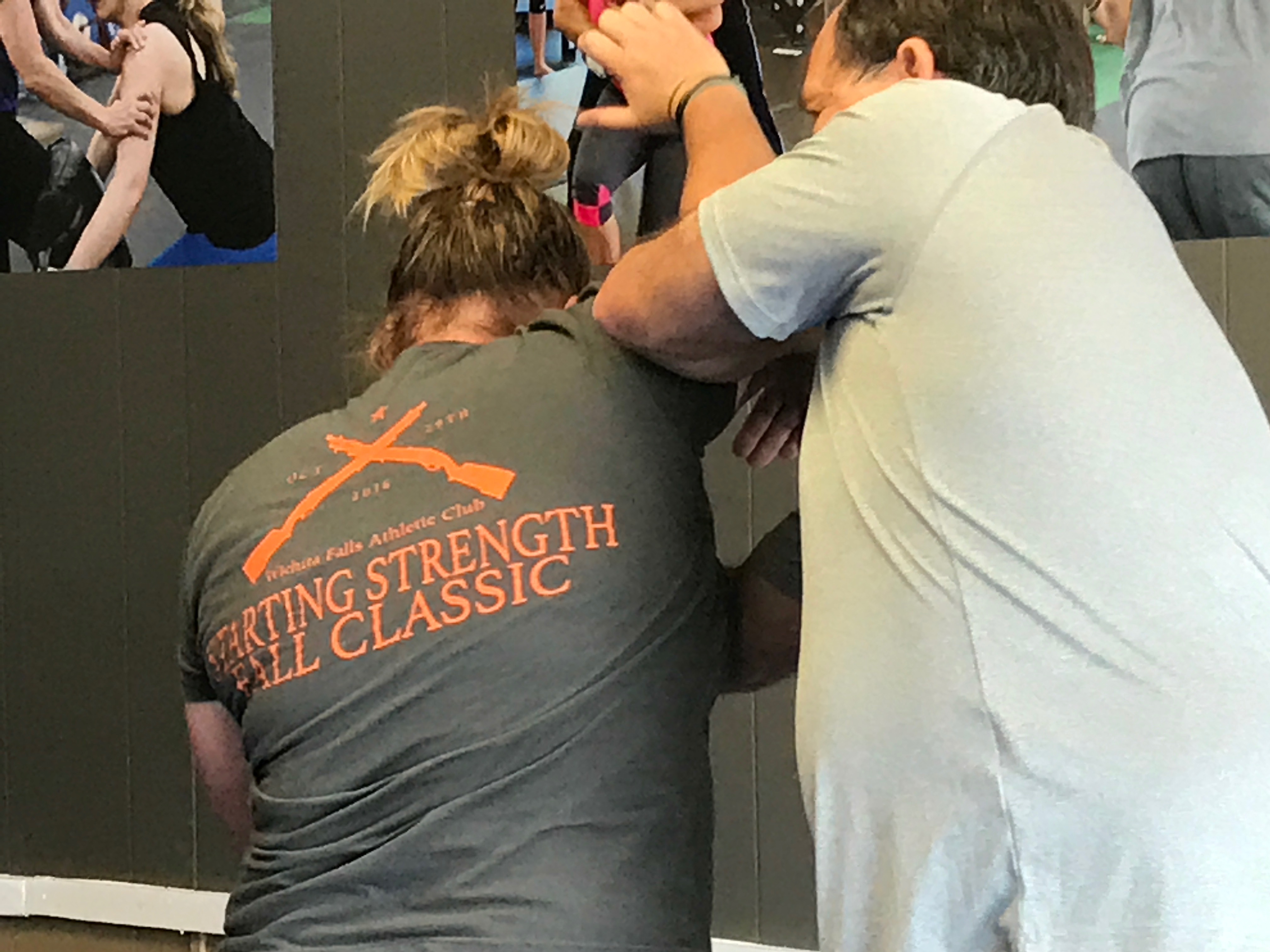
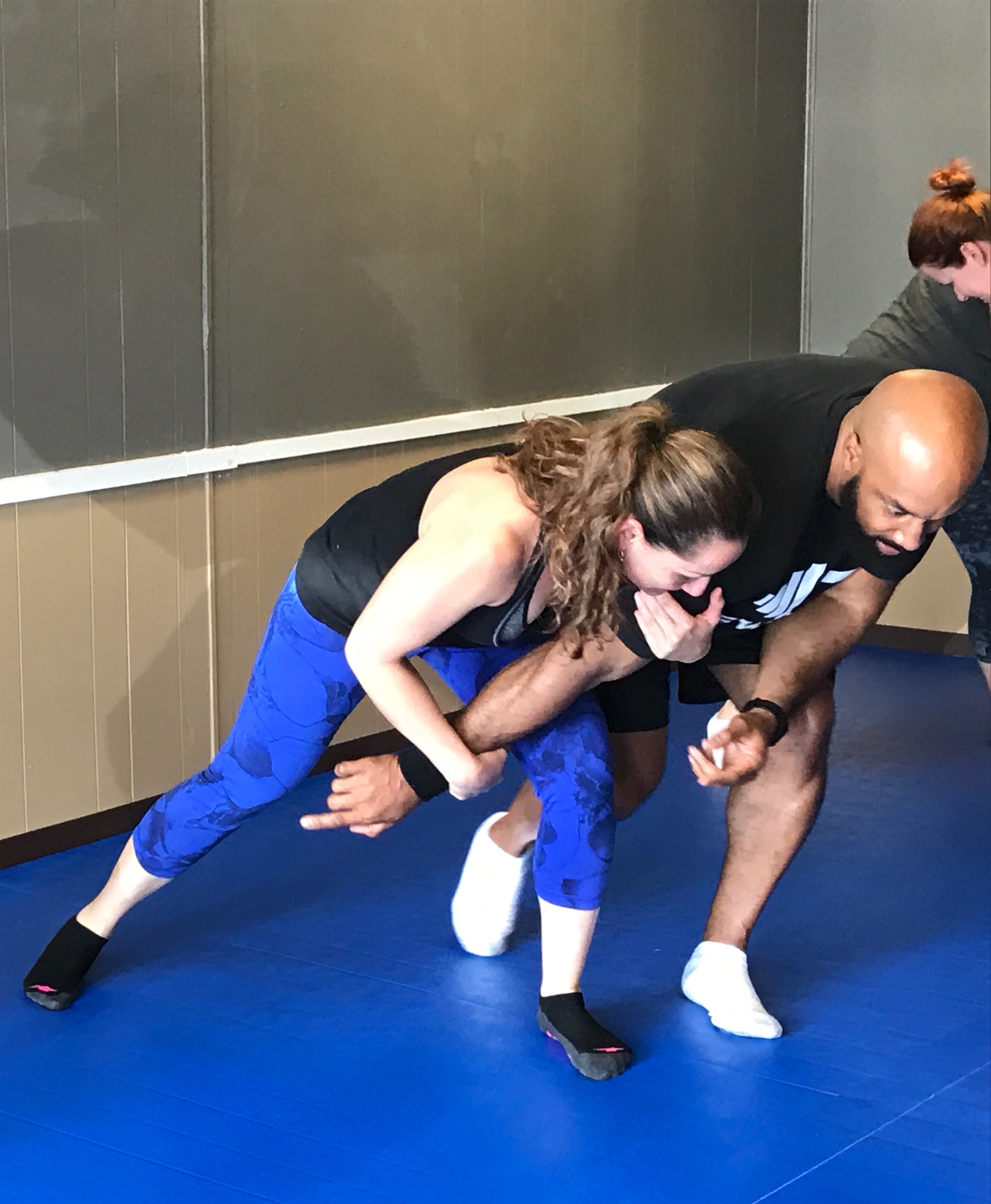
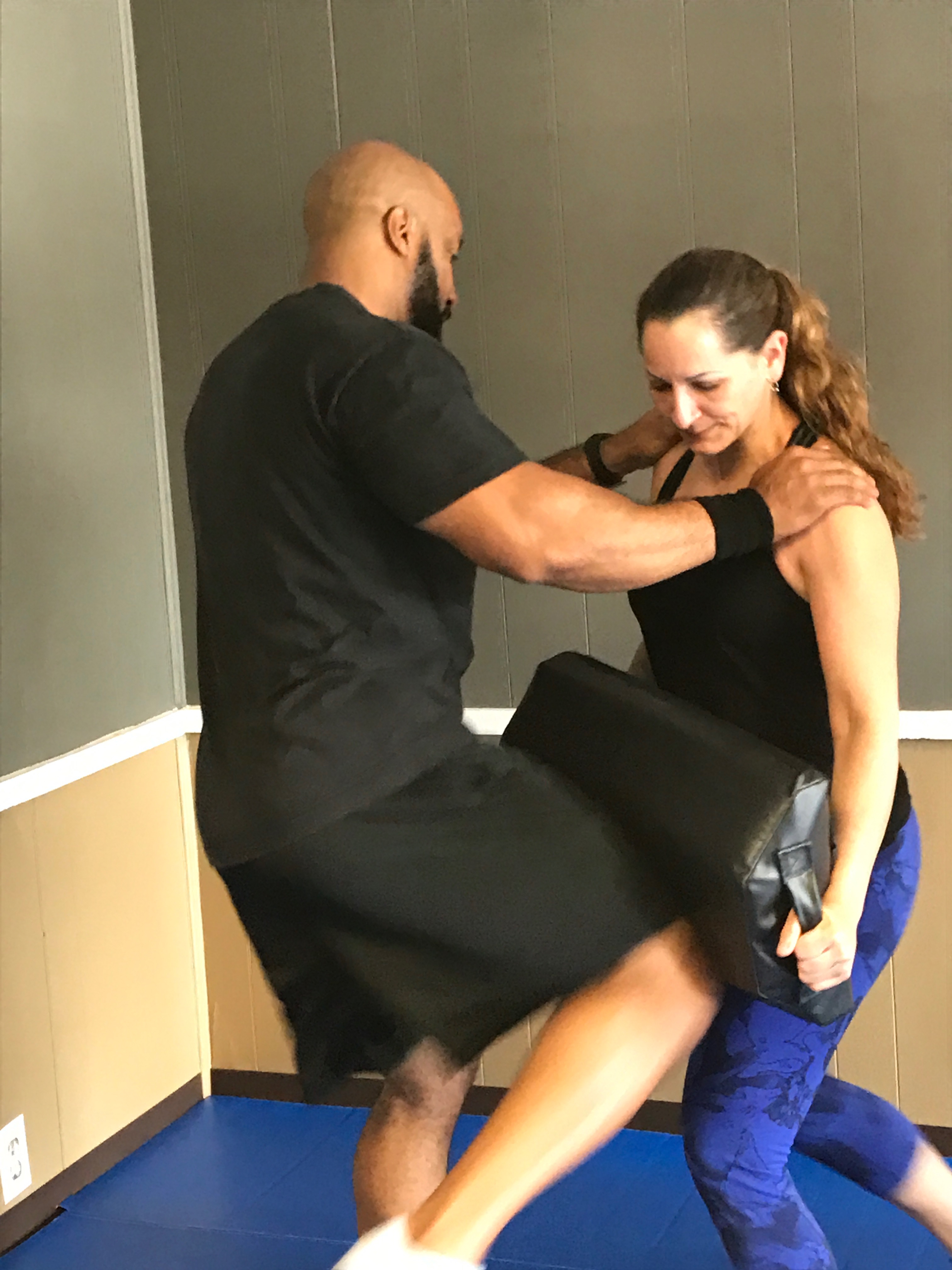
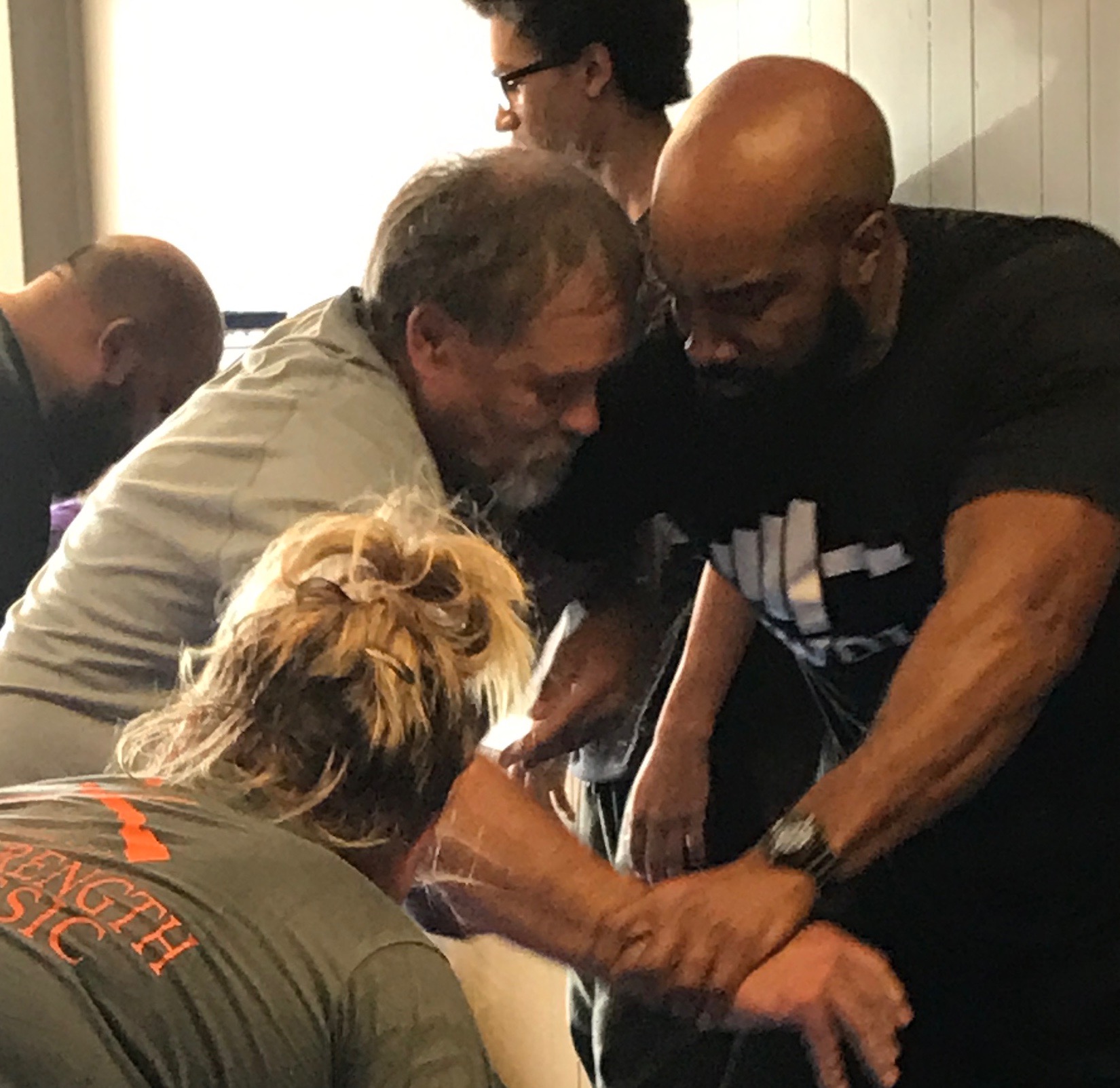
We chatted over dinner and she mentioned that she was enrolled at a local Krav Maga place, then invited us along to see what it was all about. She wanted Sheila to join in the class, but Sheila only had golf clothes in her suitcase, no workout gear. “Bring your camera,” she said.


Krav Maga (translated from Hebrew) means contact combat. Yup. That’s what the classes involve. It’s a fusion of techniques from boxing, wrestling, and judo, developed for the Israeli Defense Forces, and combined with fight training – with the end goal of self-defense.


The focus is on real-world situations and learning efficient methods to fend off attacks from the bad guys and take control of the direction of the attacks. Originally developed by Hungarian-Israeli martial artist Imi Lichtenfeld in the 1930s, Krav Maga became a practical way to combine other fighting styles (including street fighting) and teach them quickly to the Israeli military. As time passed, other techniques using elbows and knee strikes, low kicks, Aikido and Jiu-jitsu were also included under the broad umbrella of Krav Maga.

Krav Maga has a philosophy emphasizing aggression, and simultaneous defensive and offensive maneuvers. Variations of Krav Maga are now being used by military, law enforcement, and intelligence organizations around the world. The Brits and the US Marine Corps teach their own versions to their recruits.


For the average person off the street, Krav Maga teaches street self-defense using:

  • Punches, elbows, knees, and kicks.
  • Defenses against various strikes, chokes, and weapons
  • Realistic training drills.


Krav Maga also promotes awareness, strength, and self-defense skills specifically for women. Some locations have classes that focus on rape prevention techniques and tactics, to build both inner and outer strength. Women can learn to spot danger signs, but also learn how to defend against common chokes, grabs, bearhugs, and other attacks, including fighting on the ground and when confronted by a weapon. This allows women to leave class feeling safe, strong, and empowered.


The instructor for the class we attended, Nick Delgadillo, emphasized to the Level 1 group that the aim is to “defend and then attack.” As the class continued and various moves were practiced, the mantra, “As I’m striking, I need to improve my position,” became internalized.

Krav Maga is designed to be practical and intuitive for people of any age, shape, or size.

Tips and reinforcements are delivered in a positive way throughout the class:

  • If you’re pinned against a wall, the goal is to get away from the wall. Your hips have to move away from the wall.
  • If you’re being choked while shoved against the wall, break the choke and get away from the wall.
  • If you are being pushed backwards, keep your chin tucked.
  • Plan for the opponent to fight back. If they are trying to rob or hurt you, you being a nice person won’t stop them.

The Course  The progressive curriculum covers the most common types of attacks and threats first, to make students comfortable with using basic blocks, punches, chokeholds, and strikebacks. In later classes, students focus on more violent situations involving weapons, multiple attackers, and ground fighting. Krav Maga students work with each another in reality-based exercises, and the ambience is usually very supportive, yet goal-oriented.


What To Expect

Fully certified instructors guide training sessions and make sure that the environment is open and positive. Krav Maga is designed to teach students self-defense techniques in a short amount of time, with the goal that you should start feeling safer and more confident almost immediately. Students are taught how to react to the initial shock and paralyzing fear that comes with a sudden attack.


 A quote from Nick’s website:
“Defending yourself requires that you are able to make an aggressive and violent counterattack.  This is one of the ugly realities of self-defense and this is the truly hard part for nice, normal people living in the real world.  Come train with us and we’ll teach you how to make an ugly face, hit hard, and go home safe.”


Nick Delgadillo is a Starting Strength Seminar Staff Coach, Krav Maga instructor, and Muay Thai and Brazilian JiuJitsu practitioner.  He’s been teaching people of all walks of life how to fight and lift for over 10 years.  Nick is highly effective in preparing people both mentally and physically for sport, combat, or the game of life.


Notes from Patti:
Nick’s class was astounding in its content. I came away with a sense that this should be the type of self-defense class for me. If I still lived there, I would sign up in a New York minute! Bravo to Nick Delgadillo for empowering the class members, and to V. for taking me to the class.   🙂

The Kerrians are a fictional couple, but the class (V. included) and photos are real.


Save

Save

Save

Save

Save

KN, p. 199 “Krav Maga, Self-defense for the Real World” Read More »

KN, p. 76 “Save the duct tape and glue the dashboard!”

Criminals that tie their victims up during the commission of a crime frequently use duct tape for the job. That duct tape is almost always full of prints that get embedded into the tape. It’s practically impossible to manipulate and tear the tape while wearing gloves (I tried this once and the gloves got so stuck to the tape that I threw the resulting mess away), so the crook leaves prints while unrolling and tearing the tape. Even if he has wiped the smooth surface of the tape clean to cover his identity, the sticky side can’t be wiped without taking away the sticky. Balls of tape tossed aside by a suspect have been processed successfully for prints, but first the tape had to be released from itself.


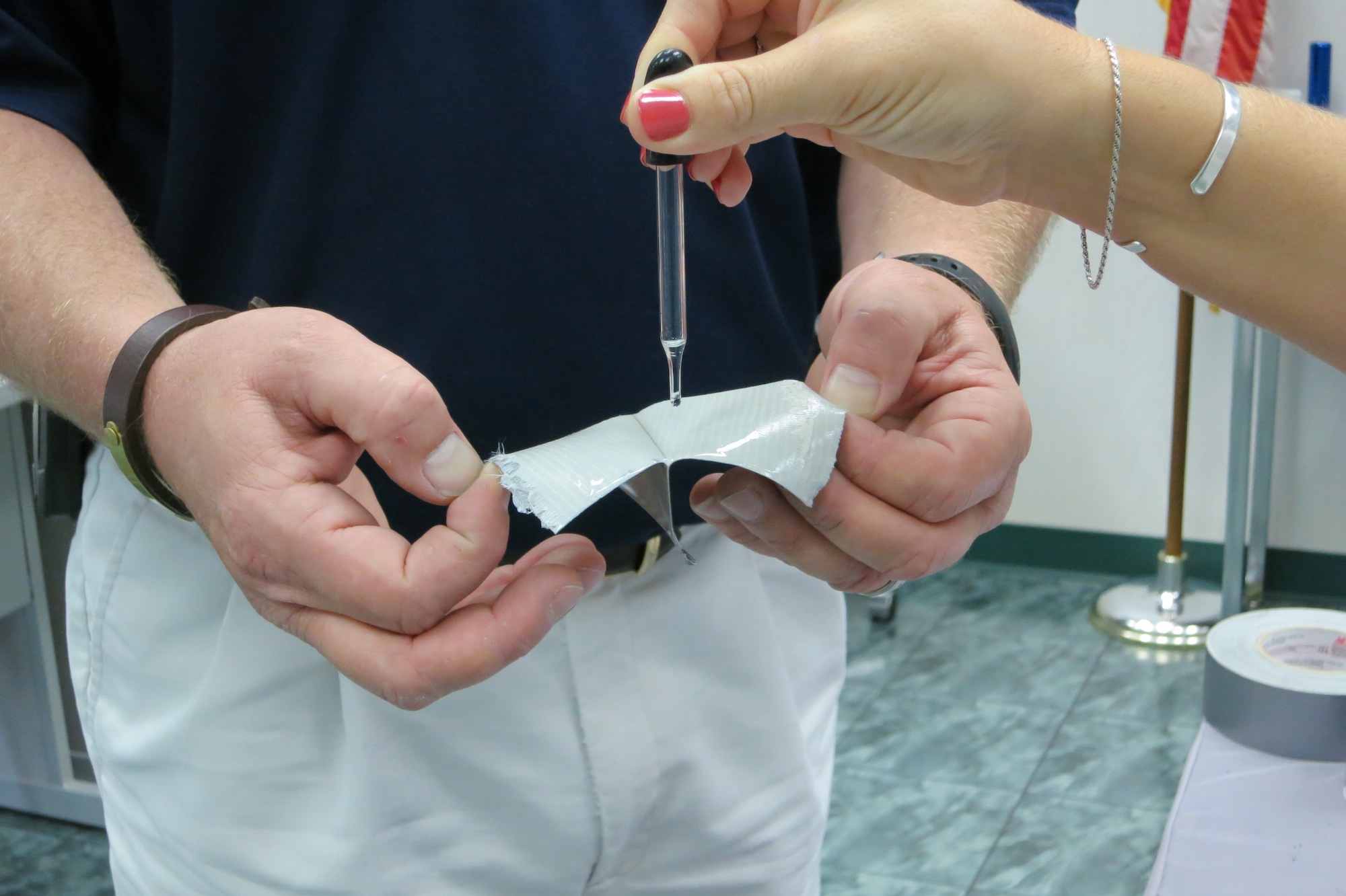
Separating folded duct tape from itself

What to do? Drop lots of a 2% chloroform tape release agent on the area where the two pieces of tape meet. Two people need to work together on this – one person places the drops continuously while the other person pulls the tape apart. The ends of the tape should then be folded over (about ¼”) and the tape flattened for 24 hours before doing anything else to it.


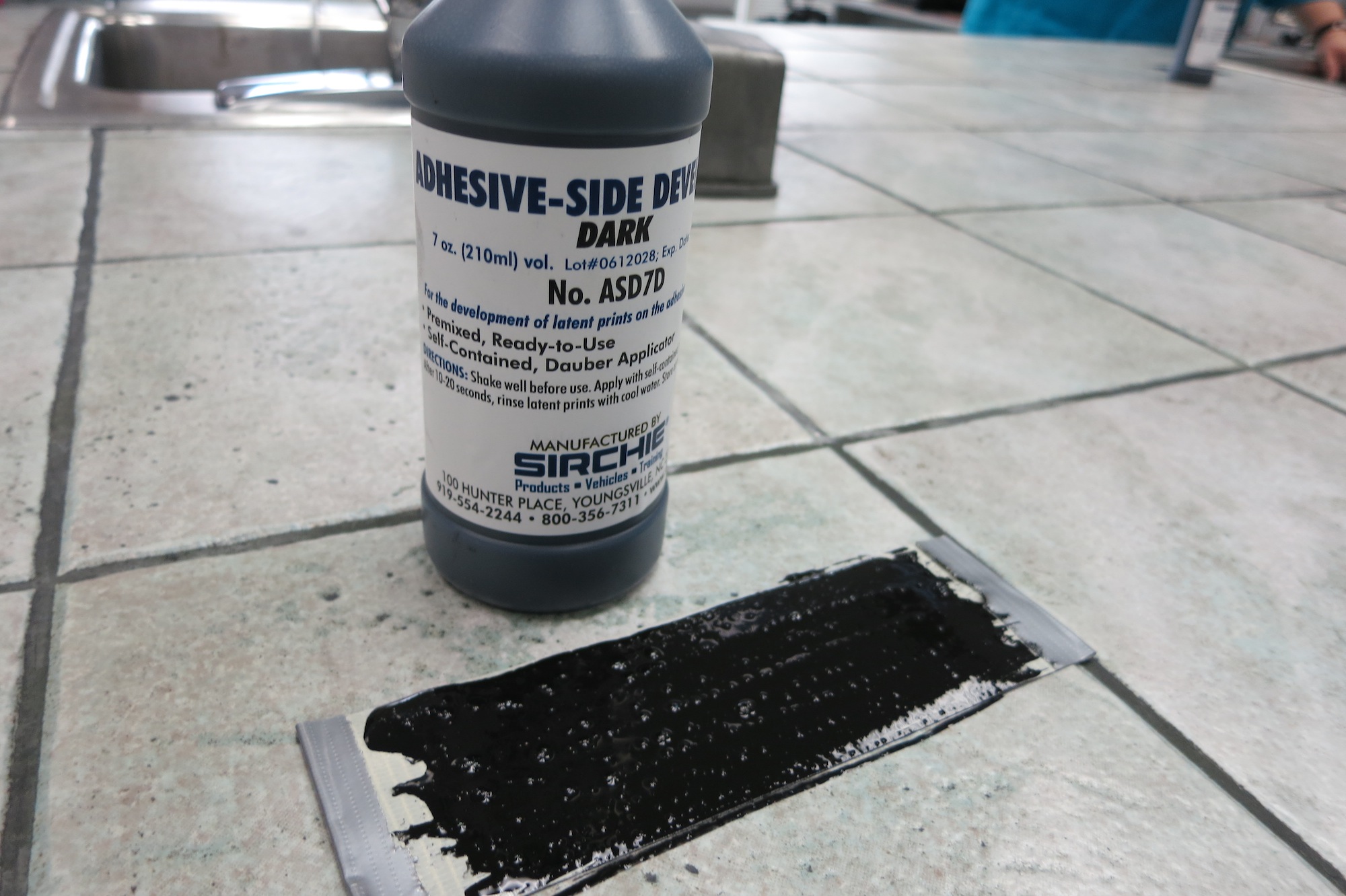
Adhesive-side developer

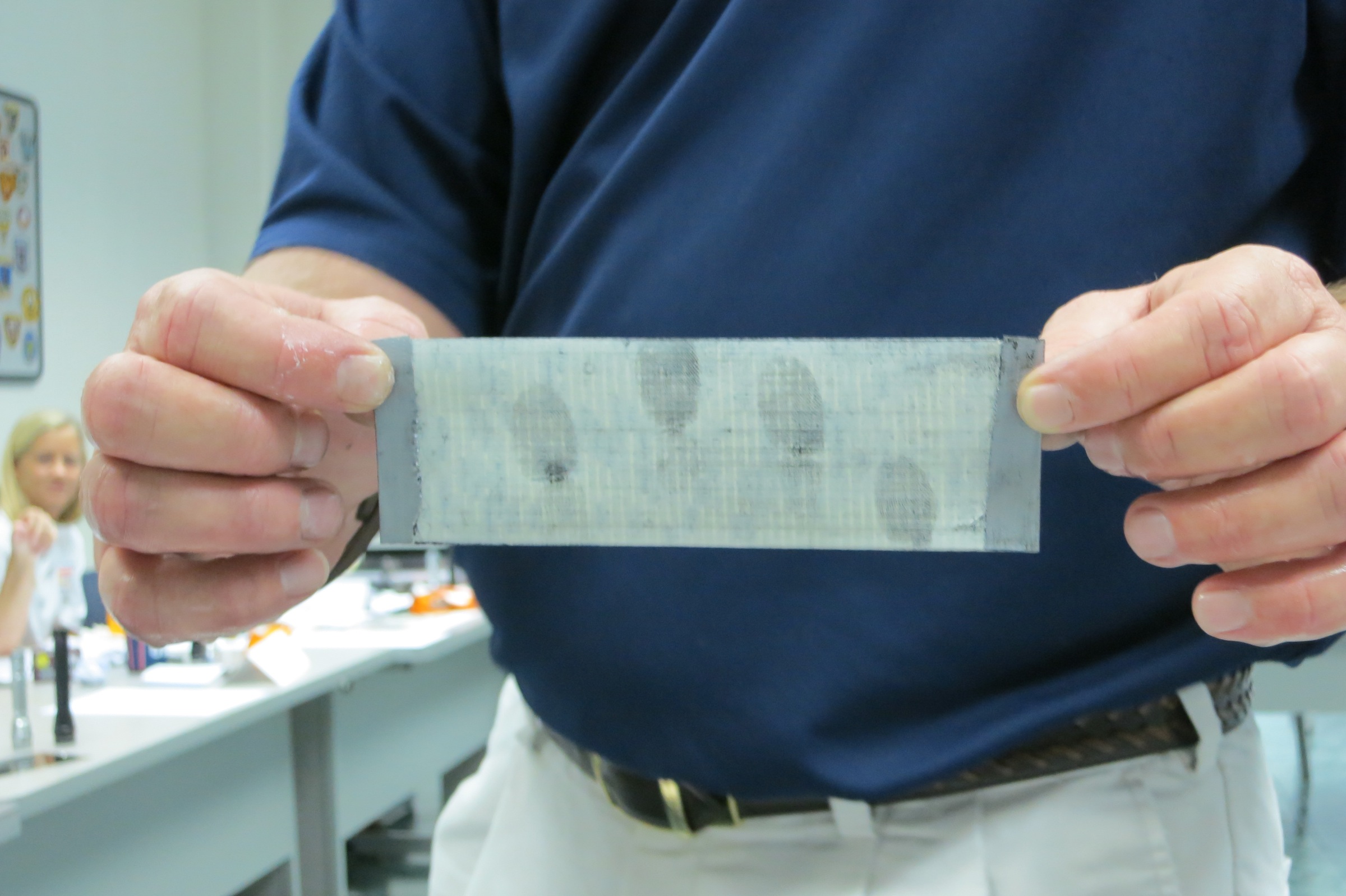
 After 24 hours, adhesive-side developer should be applied to the sticky side of the duct tape, allowed to sit for a few minutes, then rinsed off. The prints are clearly visible, can be photographed, covered with clear tape to protect them, viewed under an Optical Comparator, entered into the system, and sent off to AFIS.


Duct tape prints

Dashboard prints:

Up until recently, we could not collect decent prints from the dashboard of a getaway car in a reasonable length of time. Most car and truck dashboards have a slightly bumpy surface, more or less because it’s a selling point to non-criminal types – supposedly the pebbled surfaces mean no more pesky fingerprints to clean off if you’re a mom transporting kids after school. Sheila says the juice spills just get buried in the grooves.

But, it’s a potential fingerprint heaven for the CSIs who need to process the abandoned bank heist car. Think about it. If you press your hand onto a dashboard, your skin (with all the loops and whorls and arches and oils) is also pressing into the crevices of the pebbled surface. The problem is that a straight gel lift or hinge lifter will not pick up the prints effectively or may only pick up the top of the print.


Dashboard surface

But, the investigator sees the possible print and doesn’t want to lose the opportunity to catch the crook. The answer in the past was to dust the likely area with magnetic fingerprint powder, then apply a Blue Glue gel and wait for the gel to cure before lifting it off the dash – about five hours. FIVE hours? The crook is getting away! No time to wait!

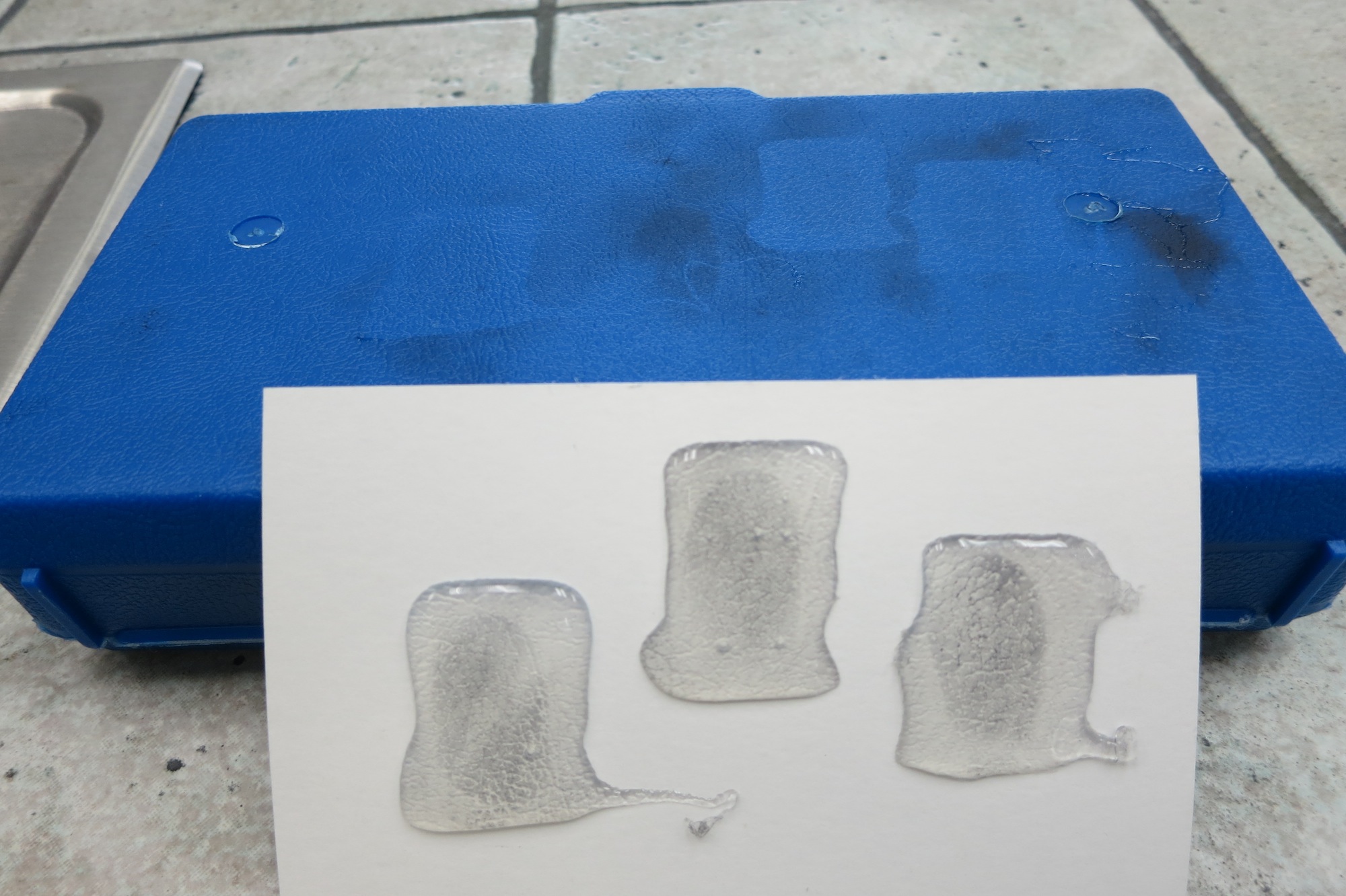
These days, the preferred lifting product (after applying the magnetic powder to enhance the print) is a transparent liquid silicone (PVS200 – polyvinyl siloxane), applied with an extruder gun. It flows down into the crevices, dries in six minutes, and gets into every bit of the print. After the polyvinyl dries, it can be lifted, and then placed on a backing card to preserve the print. At that point, it can be placed under an Optical Comparator, photographed, and sent off to AFIS for an ID/comparison.

This epoxy is not good for every surface (it rips paper, etc) but is very good for pitted, bumpy surfaces like alligator skin and dashboards. Gotcha!

Dashboard Lift

Planning to become a crime scene investigator? Then remember to collect the balls of duct tape tossed on the floor or in the garbage cans at the crime scene. Almost definitely, a great source for prints. And don’t forget your extruder gun!


*Photos taken by Patti Phillips at the Sirchie Education and Training facility in Youngsville, NC.


For more information about Sirchie and its products for the law enforcement community, please visit www.Sirchie.com.


KN, p. 76 “Save the duct tape and glue the dashboard!” Read More »

Scroll to Top