If there are no paragraph separations in this article, please double-click on the title to create a more readable version.
Warning: Some content may be too intense for some readers.
In 2005, the FBI conducted a symposium in Texas for law enforcement officers and defined serial murders in this way: “The unlawful killing of two or more victims by the same offender(s), in separate events.”
As terrifying and brutal as these events are, the FBI reports that serial murders occur in less than one percent of all murders committed in any given year.
That doesn’t mean that law enforcement treats serial murders any less seriously, just that most cops will never encounter that kind of case. When they do, the hardest part of the investigation might be recognizing that two or three murders committed across several counties could be linked in some way. Different personnel spread through different jurisdictions might not see all the facts in evidence and never see the connections, hence the reason that some serial killers are never caught.
Although not every point is true for all serial killers, there seems to be a common thread in the backgrounds of most, starting in their childhoods. Here are a few of the behaviors that appear to tie the Serial Killer category together.
Childhood abuse and/or neglect
Lousy grades in school or poor work performance, despite a high IQ
Damage to the brain’s frontal lobe – childhood head injuries
Bedwetting
Arson
Animal Torture
As possible suspects are investigated, and/or eliminated, more weight is given to those on the list who have those behaviors somewhere in their history.
Serial killers like Ted Bundy, Jeffrey Dahmer, and John Gacey all had above average intelligence, as evidenced by their ability to commit multiple crimes and evade capture (and even detection) for so many years. But Dr. Katherine Ramsland, Forensic Psychologist, maintains that even the smart ones can do dumb things.
“…serial killers range from Ivy League caliber to downright moronic. Self-defeating habits or failure to plan wisely have brought many down. It’s not all about IQ. Even smart ones can be idiots at just the wrong time.”
Examples:
Ted Bundy drove erratically in a stolen car.
Randy Kraft had a dead body in his passenger seat when the highway patrol stopped him for suspected drunk driving.
Joel Rifkin was also “transporting,” but without a license plate.
As Dr. Ramsland said, “You’d think if you had a corpse with you, you’d at least try to be inconspicuous.”
Dr. DP Lyle, cardiologist, forensic expert, and crime writer, interviewed Dr. Ramsland on his Writers Forensics blog, discussing the various descriptions of serial killers being used today.
Dr. Ramsland said, “The behaviors that stand out for budding psychopaths who are the most apt to become violent involve unmotivated deception, tendency to blame others, callous disregard, and ADHD – a combination of them all. Such children will tend to manipulation, deflect responsibility, damage property, steal, do poorly in activities that require sustained discipline and focus, and play cruel pranks. They will also exercise their need for control on others who are weaker, including animals, and this could involve experiments, mutilation and killing.”
For more information about the criminal mind, Dr. Ramsland is the author of dozens of books and articles on the subject. One of her titles, “Confessions of a Serial Killer,” is the untold story of Dennis Bader, the BTK killer. Scary stuff.
The average person is unlikely to interact with a serial killer, but many law enforcement officers or profilers get specific training in order to keep it that way – to keep the community safe from predators. It has been found that not all serial killers work alone, and a good percentage (around 15%) are women.
How do you keep from becoming a victim?
Don’t go out with people you don’t know.
Don’t get into cars with people you don’t know.
Don’t go shopping at night by yourself.
Park your car in well-lit areas and lock it.
If your car has a flat tire in a grocery store parking lot, go back into the store to get help. Don’t accept assistance from a stranger who just happens to be near your car.
Become familiar with self-defense techniques. Take a class to become proficient.
Use common sense, be extra aware when alone, and stay safe!
If there are no paragraph separations in this article, please double-click on the title to create a more readable version.
Continuingthe series of articles about Evidence Collection Training Classes held at SIRCHIE.
Part 4 – “Quick! Grab the glue gun!”
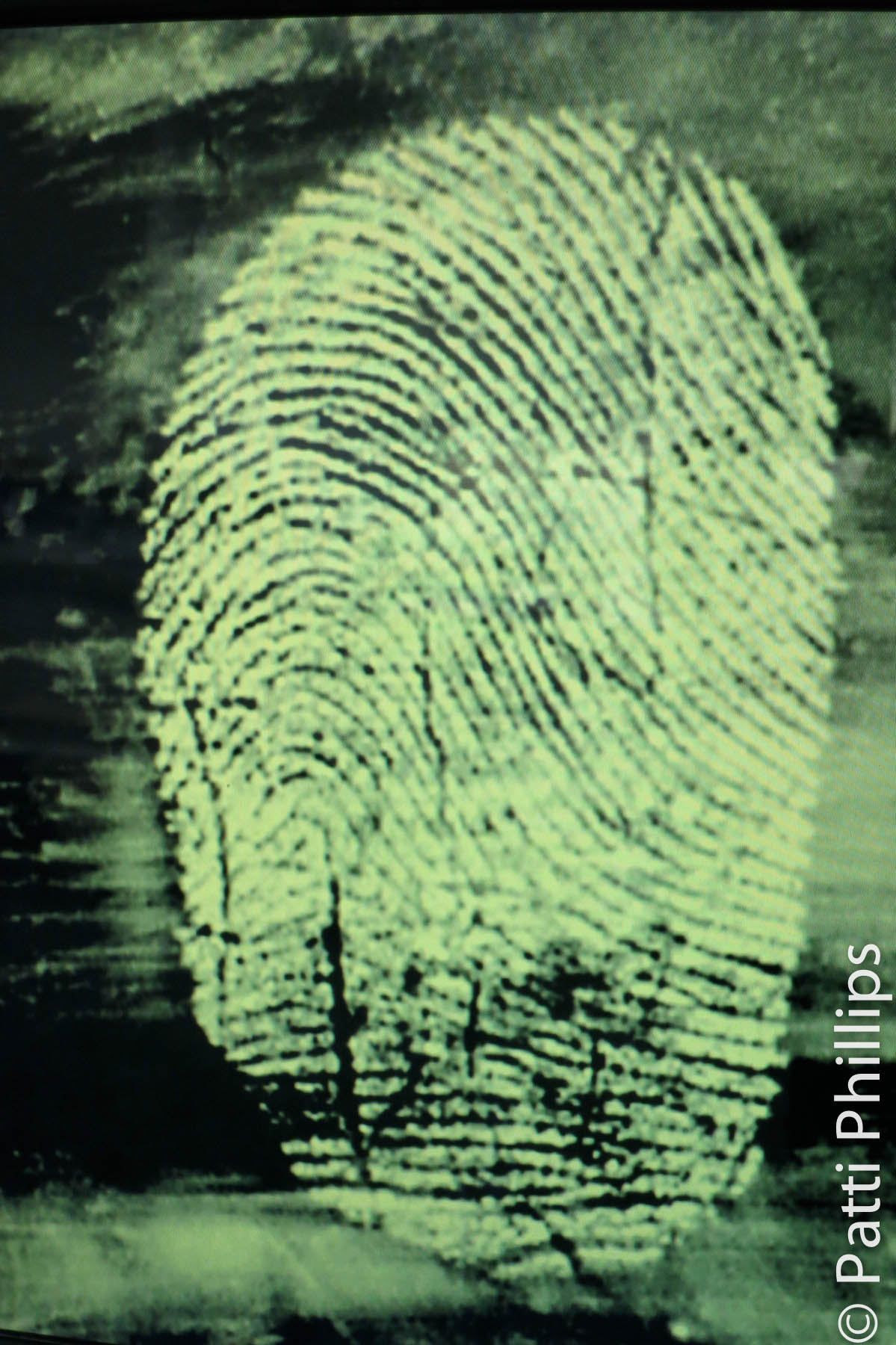
Wet Lift Print as seen on a Comparator
We often hear it said on TV and in the movies that there are items and surfaces that do not hold fingerprints or that fingerprints cannot be recovered from them. On Day #4 of the Sirchie Evidence Collection Training Classes held at the Sirchie Fingerprint Laboratories in NC, we experimented with a variety of surfaces to see what would happen if…
Skin is reported to be one of the most difficult surfaces from which to lift a print, because the prints fade so quickly. But, after three days of dusting and chemically treating and lifting and photographing dubious fingerprints, our group of dogged writer/investigators was not to be deterred.
The set of prints in the photograph below were lifted from an arm. Not clothing, the arm itself. And not by using fingerprint powder on the arm. A classmate kindly offered up her arm to be grabbed. Then a piece of specially treated paper (chromicoat) was pressed onto the area of her arm where the fingerprints were likely to be found. That paper was then dusted with fingerprint powder and the prints popped up. We now knew it was possible to lift the prints if they were minutes old, but we had access to both the specially treated paper and the powder immediately after the grab. We also knew from experience that our grabber always left really good prints on all the surfaces touched during the previous days.
Lift from skin using Chromicoat treated paper
We proposed various scenarios to our instructor (equally curious Robert Skiff, Sirchie Training Manager/Technical Training Specialist). What if a mugger grabbed a bare arm and tried to drag us into an alley? How close would we have to be to the police station after we got away from the mugger in order to get the prints processed? How much time did we have before they faded away? Would the lift work if we used plain paper, since it was highly unlikely that an ordinary gal would be carrying chromicoat paper in a pocket? What if the police station wasn’t close by, therefore no access to fingerprint powder?
The answers were time sensitive. It was possible to lift prints from a bare arm with plain paper, but only if the lift was made during the first few minutes and only if the suspect left a strong sample. It’s possible to use cigarette ashes as a substitute for the fingerprint powder. Conclusions? There were too many variables for this to be a reliable way to catch a crook. Now…if you were grabbed around the corner from a police station OR were a smoker AND the mugger had dirty hands AND you had a clean piece of paper in your pocket AND you had attended this class… Hmmm…maybe in a sci-fi mystery. However, not completely impossible.
Another difficult surface from which to lift prints is the dashboard of a car. Think about it. If you press your hand onto a dashboard, your skin (with all the loops and whorls and arches) is also pressing into the crevices of the pebbled surface. Same thing is true for an orange or a football. A straight gel lift or hinge lifter will not do the job effectively. A tape lift may only pick up the top of the print.
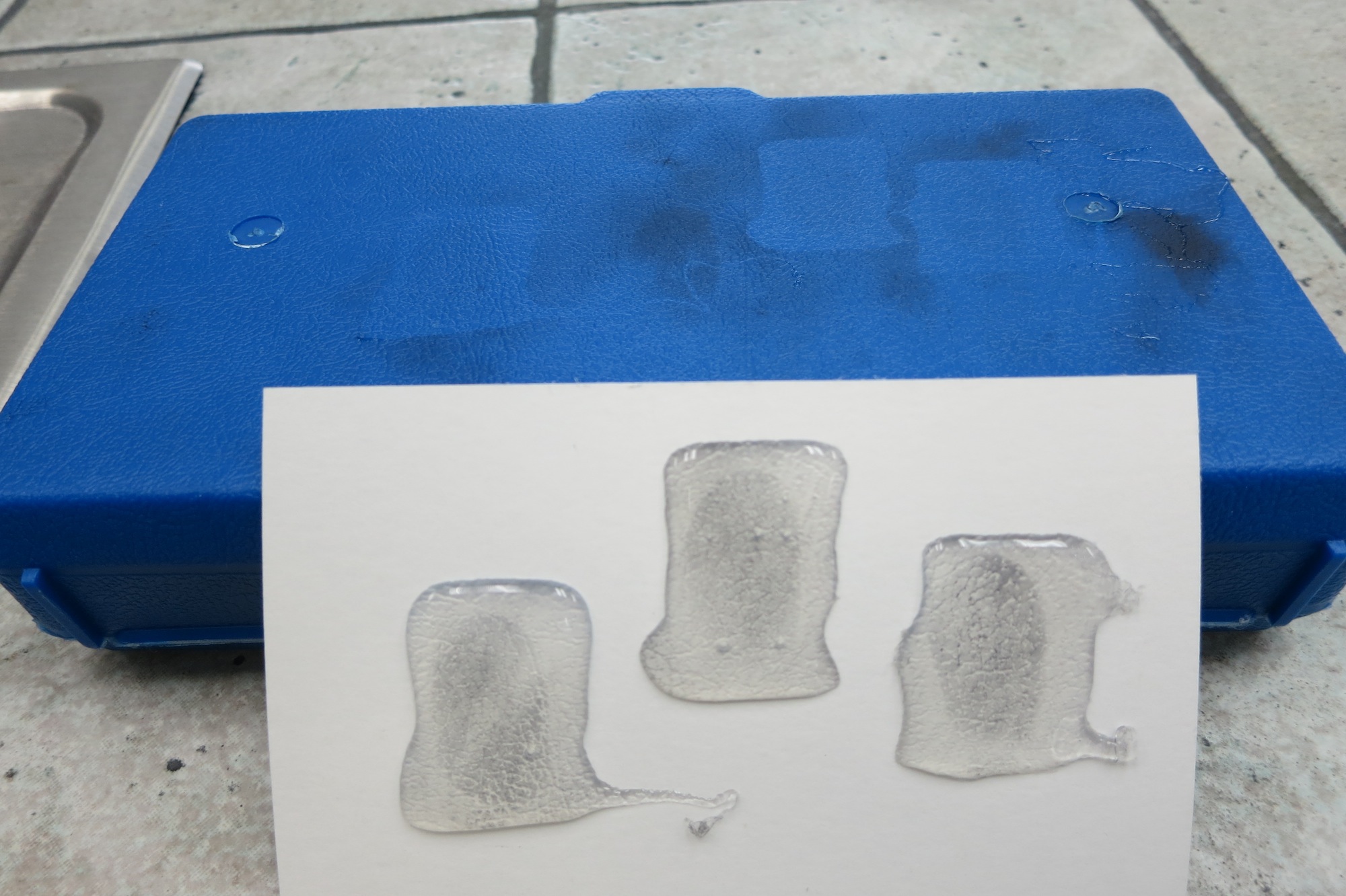
Dashboard surface
But, the investigator sees the possible print and doesn’t want to lose the opportunity to catch the crook. The answer in the past was to dust the likely area with magnetic fingerprint powder, then apply a Blue Glue gel and wait for the gel to cure before lifting it off the dash – about five hours. FIVE hours? The crook is getting away! No time to wait!
These days, the preferred lifting product (after applying the magnetic powder to enhance the print) is a transparent liquid silicone (PVS200 – polyvinyl siloxane), applied with an extruder gun. It flows down into the crevices, dries in six minutes, and gets into every bit of the print. After the polyvinyl dries, it can be lifted, and then placed on a backing card to preserve the print. At that point, it can be placed under an Optical Comparator, photographed, and sent off to AFIS for an ID/comparison.
This epoxy is not good for every surface (it rips paper, etc) but is very good for pitted, bumpy surfaces like alligator skin and dashboards. Gotcha!
Dashboard Lift
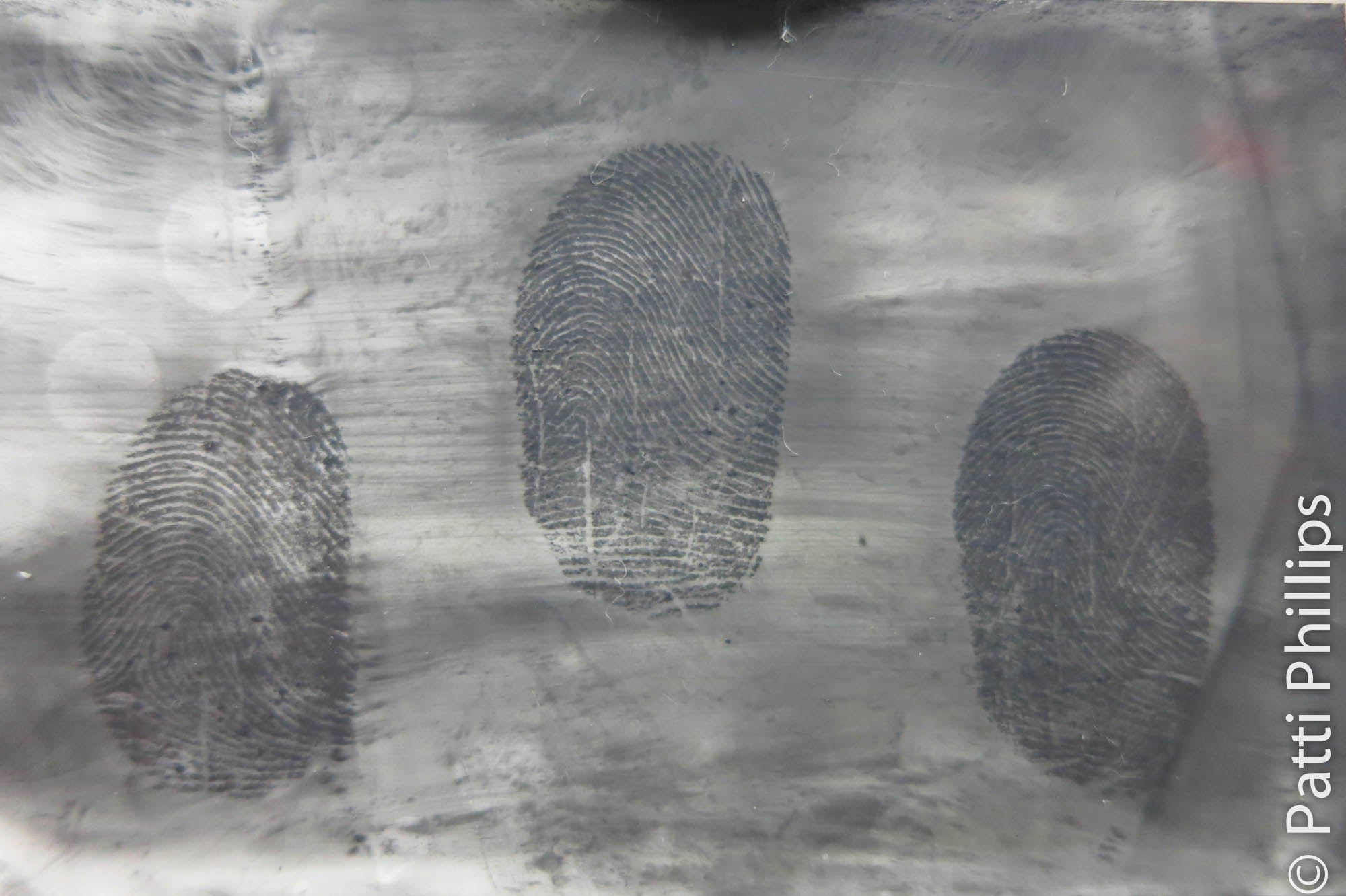
Another tricky scenario: The cop is in pursuit of an unidentified car thief or robber and chases him through a parking lot. The cop witnesses the suspect firmly planting his palm on the trunk of a car as he cuts through a tight space. The cop grins as he realizes that even if the guy outruns him, he can catch him through the palm print. And, then, it starts to pour. Does the print get washed away? Or become unusable?
Not if the Field Kit is handy! When forced to do a wet lift, it is possible to use SPR (Small Particle Reagent – finely ground particles suspended in a detergent solution). Spray the print with a fine mist of SPR and let set. Lay the hinge lifter just off the print and place it down carefully, employing a squeegee at the same time, to slowly remove the excess water. This method can be used to develop prints on non-porous surfaces – cans, bottles, windows, and other glossy surfaces, but not on paper or cardboard.
Wet Lift Prints
Criminals who tie their victims up during the commission of a crime frequently use duct tape for the job. That duct tape is almost always full of prints that get embedded into the tape. It’s practically impossible to manipulate and tear the tape while wearing gloves (I tried this once and the gloves got so stuck to the tape that I threw the resulting mess away), so he leaves prints while unrolling and tearing the tape. Even if he has wiped the smooth surface of the tape clean to cover his identity, the sticky side can’t be wiped without taking away the sticky. Balls of tape tossed aside by a suspect have been processed successfully for prints, but first the tape had to be released from itself.
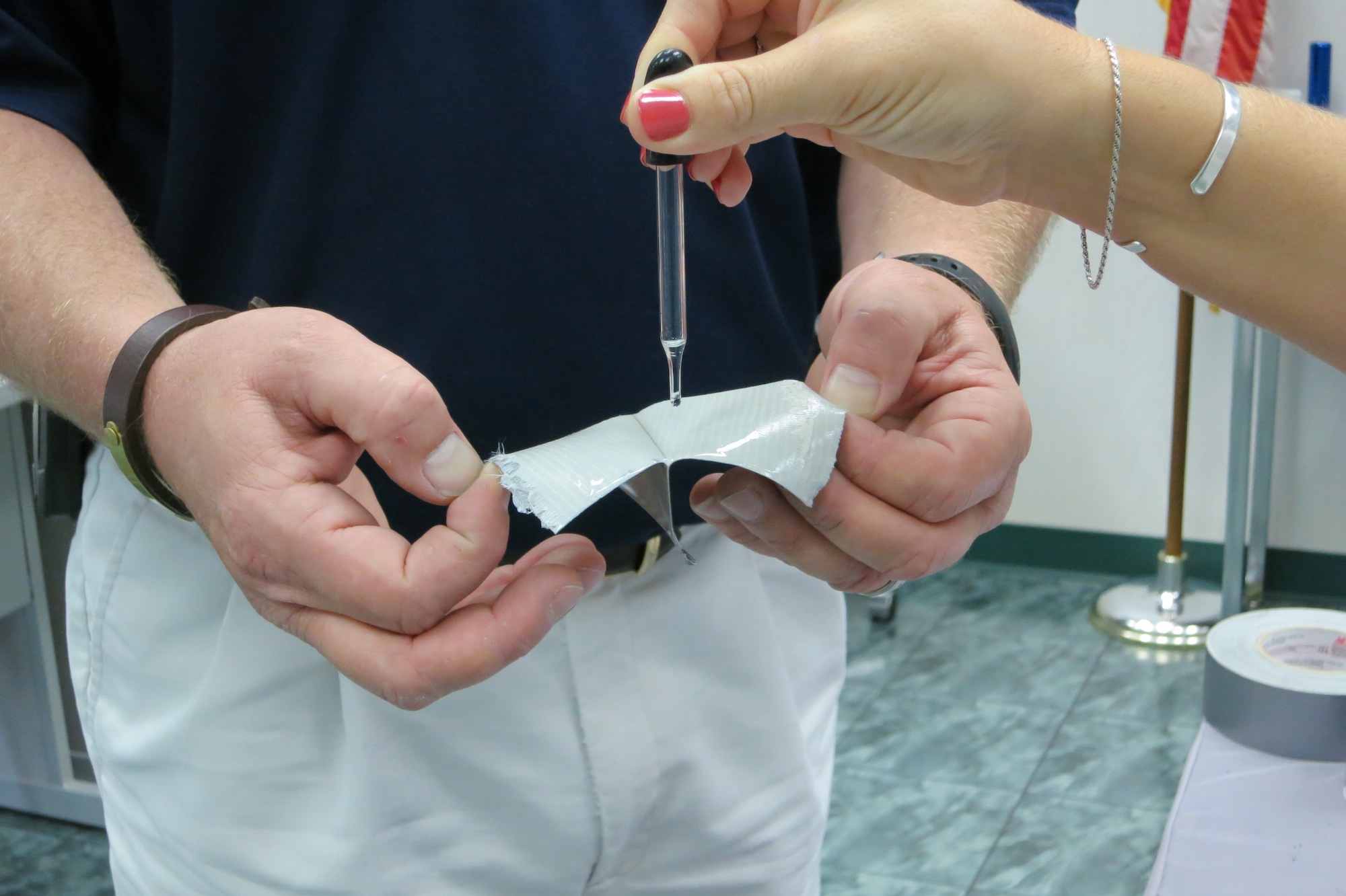
Separating folded duct tape from itself
A 2% chloroform tape release agent is dropped liberally on the area where the two pieces of tape meet. Two people need to work together on this – one person places the drops continuously while the other person pulls the tape apart. The ends of the tape are folded over (about ¼”) and the tape is flattened for 24 hours before further processing.
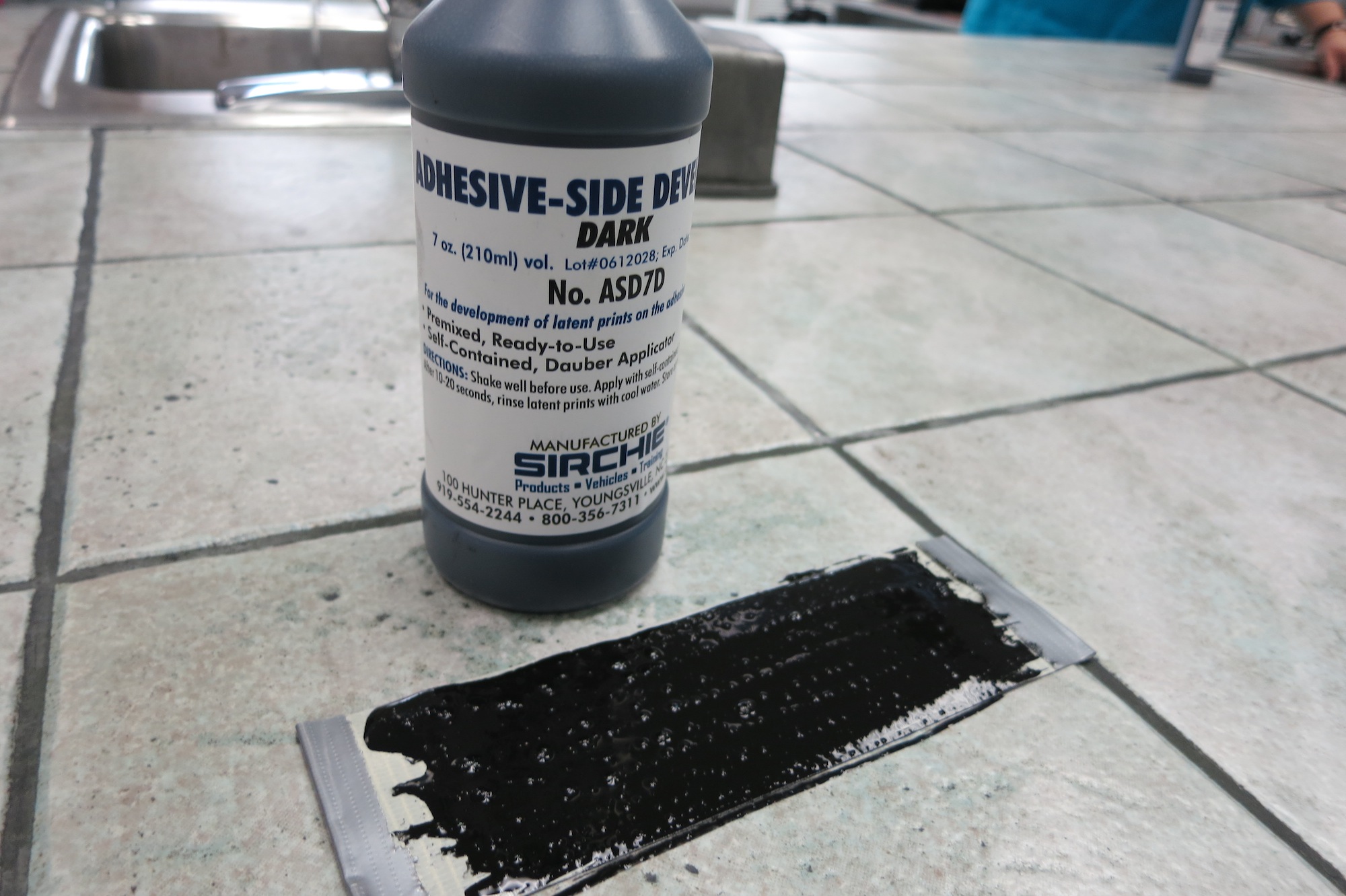
Adhesive-side developer
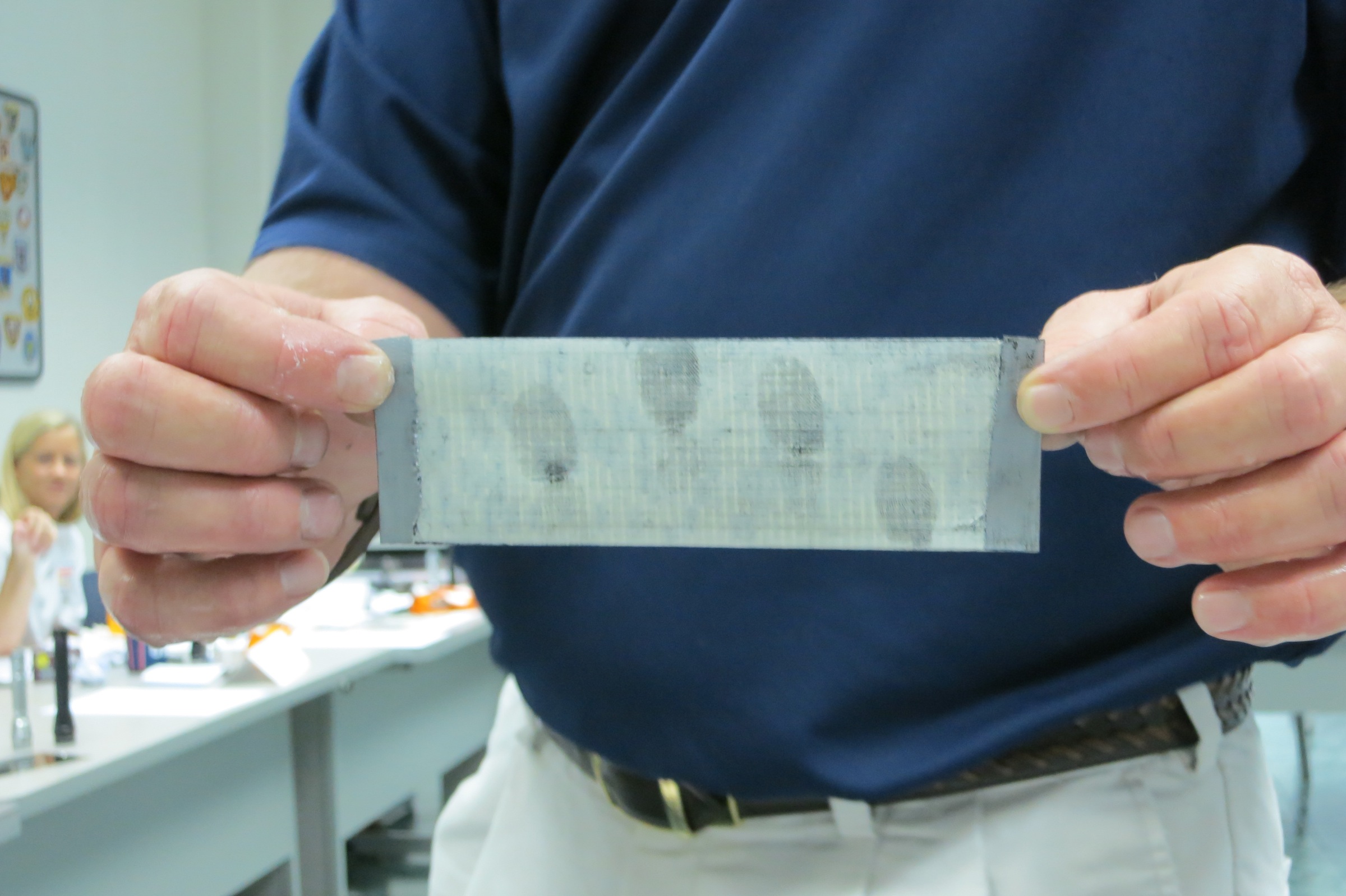
After 24 hours, adhesive-side developer is applied to the sticky side of the duct tape, allowed to sit for a few minutes, then rinsed off and voila! The prints are clearly visible, can be photographed, covered with clear tape to protect them, viewed under the Optical Comparator, entered into the system, and sent off to AFIS. (Crystal Violet can also be used for processing this type of print, but is toxic and should only be used in a lab.)
Duct tape prints
AFIS – what is it and does it really help identify a person of interest in a crime?
Anyone who has watched TV crime shows during the last decade has heard the acronym AFIS. It stands for Automated Fingerprint Identification System. In 1924, the FBI started a fingerprint identification system. They fingerprinted several thousand prisoners incarcerated at Leavenworth, and stored their prints on cards.
As of 2012, the system had broadened to include international prints as well, is an electronic database of 70 million, and contains the prints of both law-abiding citizens as well as those of criminals. While newborn babies are printed, their information is usually entered into a local system unless needed in an abduction case. Real estate agents, childcare workers, Federal employees, and people seeking employment with security and law enforcement agencies are fingerprinted as a matter of course now. Depending on the State, the prints are entered into the State AFIS system, and held until needed in the national system. The fingerprints of any person arrested for any level of crime are sent to the State and then on to the national FBI database. The latest FBI version is named IAFIS (I is for Integrated).
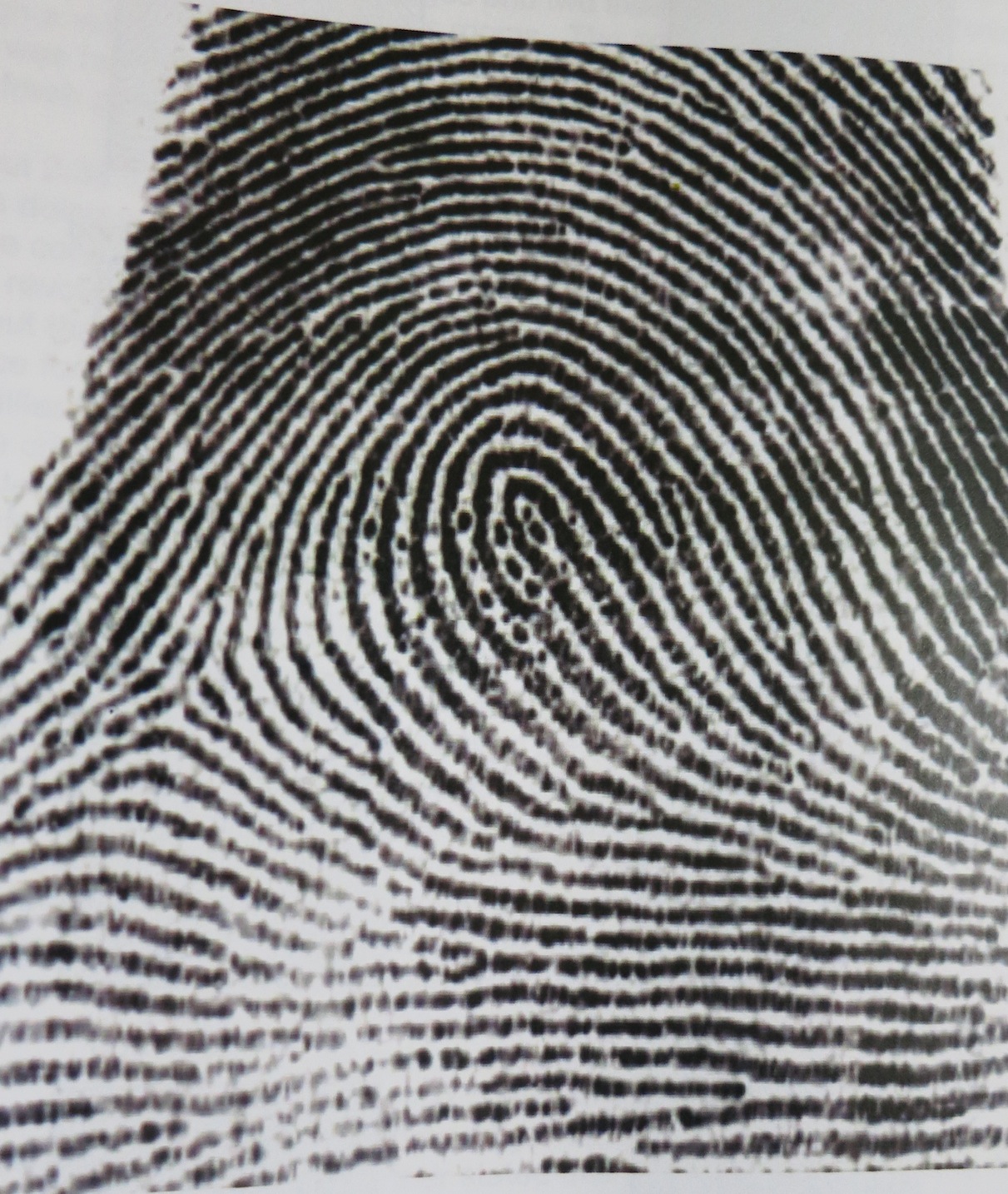
Johnny Leonard, a latent fingerprint expert, visited the class in the afternoon to explain what AFIS can and can’t do. He showed us what a fingerprint examiner looks for in every print or partial print he/she sees, using the Henry Fingerprint Classification and Identification method. The average number of minutiae on every complete print is between 100 and 150. There are distinct ridge patterns to look for in a print: arches, loops and whorls.
Fingerprint Loops 65% of all fingerprint patterns are loops, Fingerprint Whorls
30% are whorls,
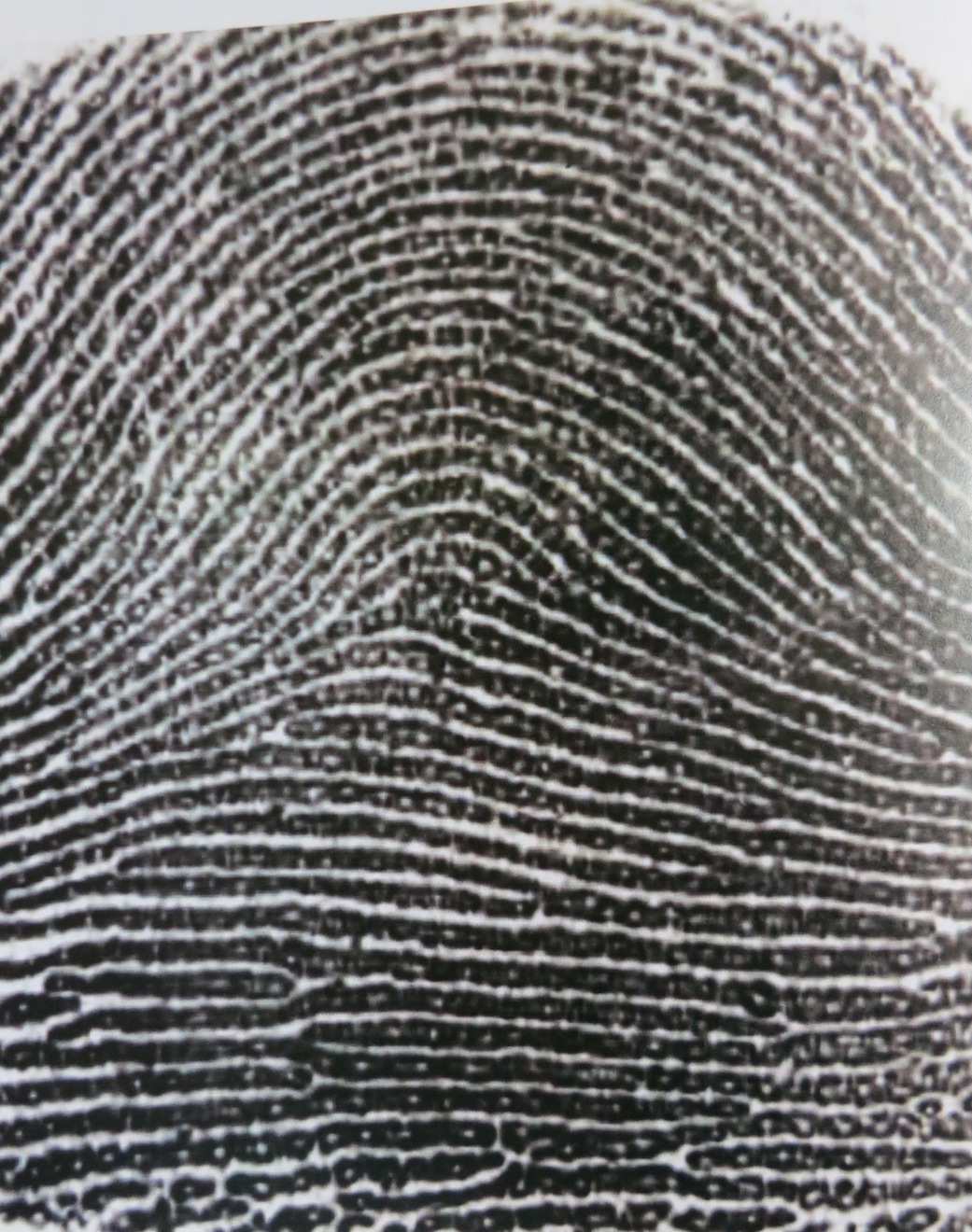
Fingerprint Arches
and only 5% of fingerprint patterns are arches.
Thumb prints are the prints most often left at a crime scene, because people use their thumbs for leverage when pushing through doors or opening safes, or grabbing those golf clubs to use as weapons, etc.
Identifying 8-12 points of similarity between an unknown latent print found at a crime scene and one in the AFIS database is the standard for declaring a match, but some jurisdictions want more for absolute certainty. An examiner plots the print in question for distinct characteristics, makes notes to that effect before sending the print off and waits. AFIS & IAFIS return a list (sometimes as many as 30) of possible matches. At this point, the examiner reviews the possibles and chooses the best match in his/her opinion. And, it might not be the first on the list. Then, another examiner verifies the possible match. There is no such thing as an instantaneous match with just one print from the AFIS or IAFIS databases. TV tells us otherwise, but sorry, that’s merely for dramatic effect.
Other interesting fingerprint details:
*We know that no two people can have the same fingerprints, but not even the same person’s prints are identical.
*Some people have all three types of ridge patterns on one finger.
*Only positive matches from the state AFIS are verified by examiners; not the negative ones.
*Palm prints are now in the AFIS database.
*AFIS looks for change of direction in the whorls, loops, and arches in order to find a match.
*There has not been a case yet where the DNA has not matched the fingerprints at the scene.
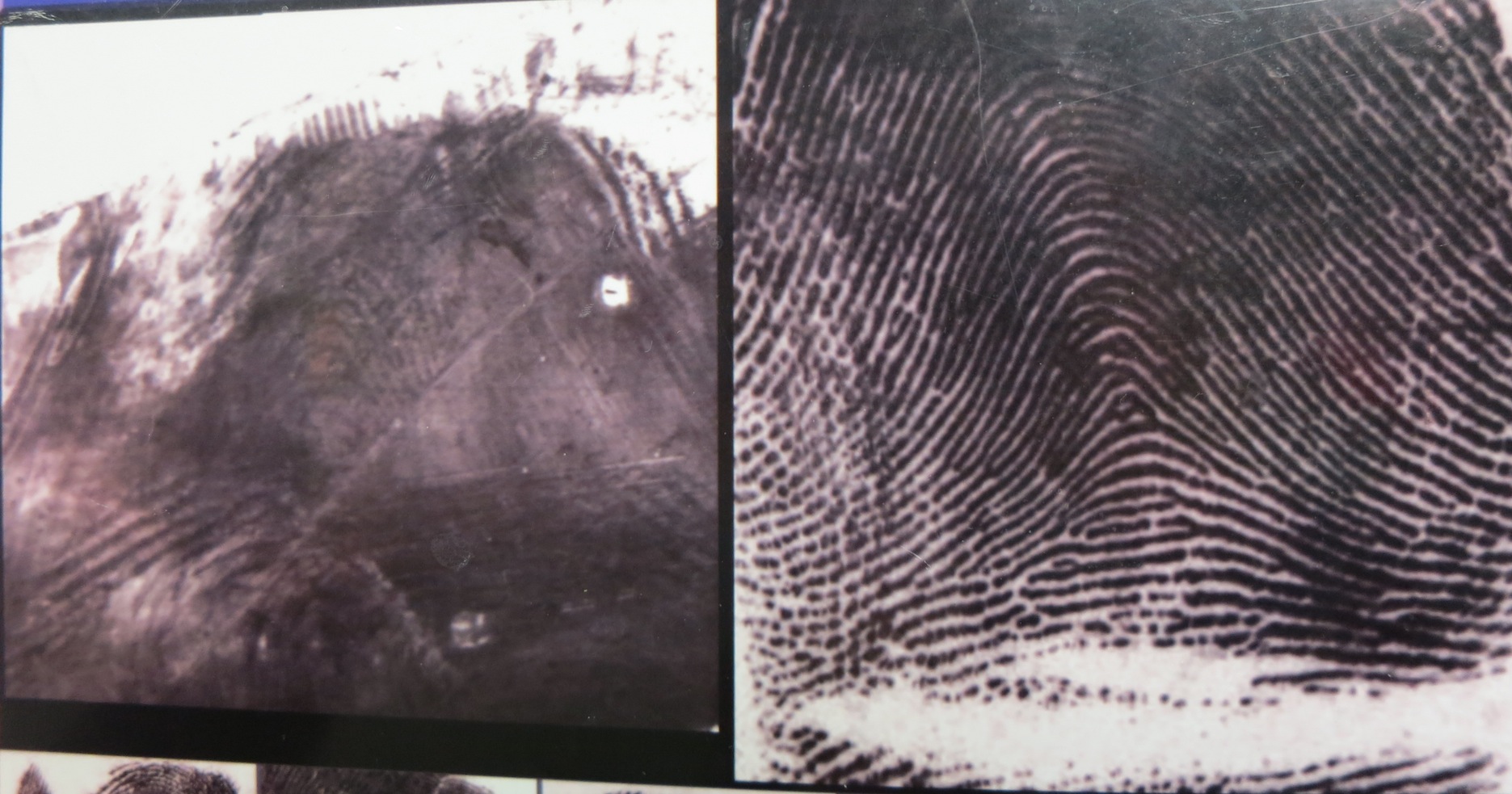
The photo below shows a positive match between a latent print and one in the database. The latent is on the left. The database print is on the right. This match placed the suspect at the scene and along with other evidence, resulted in a conviction.
AFIS match
Having been through four days of training, working with prints on a variety of surfaces, we felt confident that we were up to the challenge of matching a few fingerprints on our own. Mr. Leonard showed us 16 pairs of prints and gave us 15 minutes to make decisions. We looked for cluster highlights, tented arches, spots, bifurcations and other techy details. Guess what? The lines began to blur, and not all of us correctly identified all the matches.
TV makes it look easy, with a click and a less than five-minute response time from IAFIS. Not possible, with 70 million fingerprints to choose from. This is not an easy job, even with the new digital readers that speed up the process of finding likely matches at the scene.
Click here for Part 1 – “Have you been fingerprinted?”
Click here for Part 2 – “Where are the Evidence Collection kits made?”
Click here for Part 3 – “Can’t get rid of the blood?”
*Photos taken by Patti Phillips at SIRCHIE Education Training Center in Youngsville, NC.
If there are no paragraph separations in this article, double-click on the title and they will appear. 🙂
Read Part 1: “Underwater Evidence and Body Recovery: Lakes and Bodies” here.
Part 2 of “Underwater Evidence and Recovery” covers some of the search methods available to rescue and recovery dive teams.
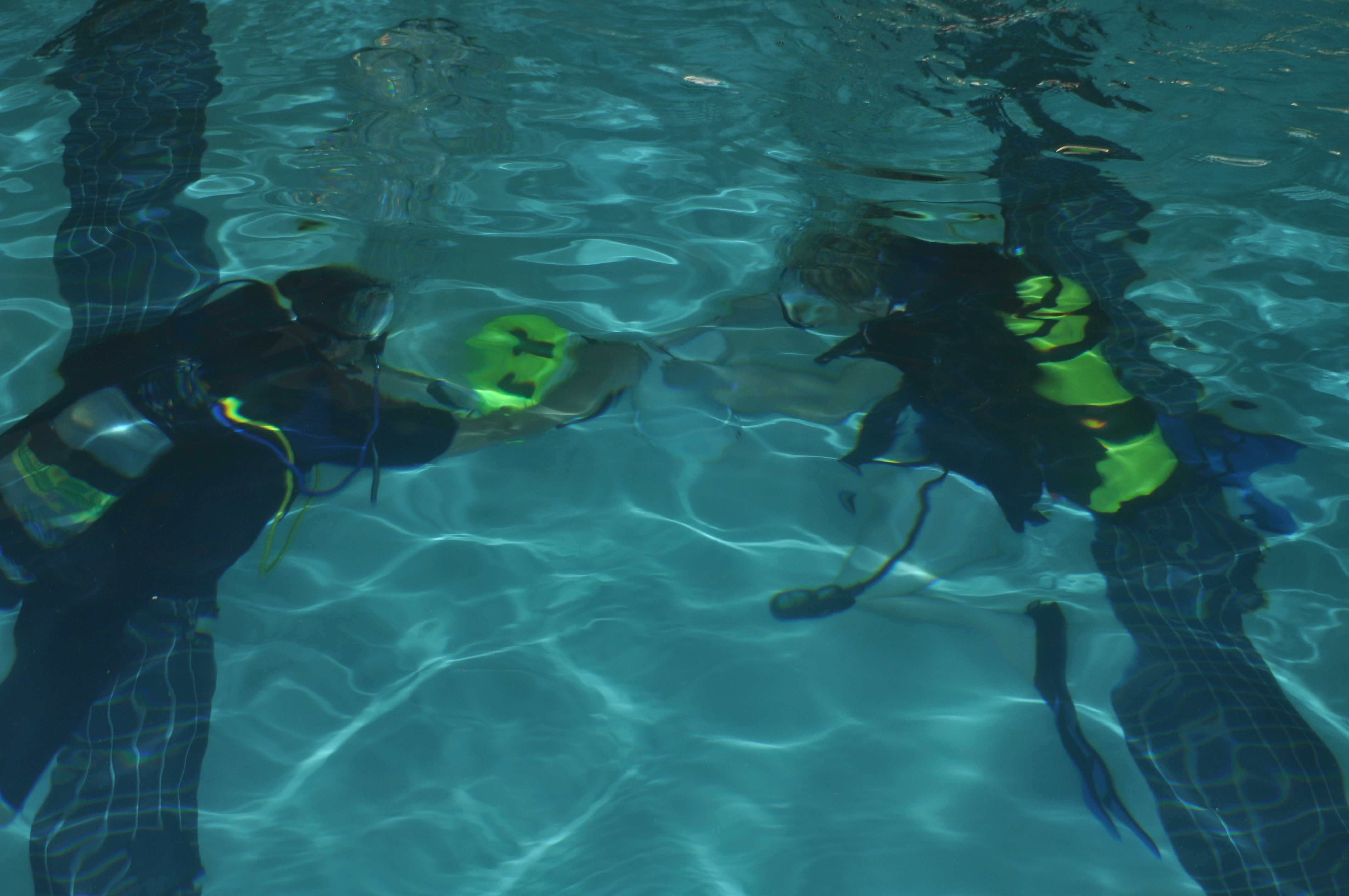
Evidence has been found and tagged with rope and buoy.The evidence team works together to place the evidence in the container while underwater.
The divers each have different roles. In a three member team, one does the bagging and tagging and the other has primary responsibility to bring the evidence or a body back. The divers try to stay with the bag on the way up, so it doesn’t get snagged on rebar, fish hooks, or other debris known to be present in ponds and swamps. The large pond near my house has castoff evergreen trees around the edges – great hiding places for fish, but tough to work around when moving retrieval equipment near them.
One search method for remains thought to be in shallow, but cloudy, ponds is to form a ‘skirmish line.’ The team members lock arms and walk the area, to see if they can bump into the body. In deeper water, grappling hooks might be used if there is a suspicion that a body is snagged on a log or other large object. Sometimes, peopledrown in their cars after going off a road, and must be extricated before the car is towed out.
As upsetting as it might be to the families of missing loved ones, searches cost money. The men and women in charge of the searches must weigh their past experience in finding people under different circumstances and decide when to call it off officially.
Highly experienced divers have found bodies and evidence at a depth of fifteen feet, where it is extremely cold and almost pitch black. It’s not always possible to recover anything at that depth, with currents, storms, or toxic waste in the mix.
Searches are conducted with ropes because of the zero visibility.The bottoms of lakes are silky and murky and the divers see shades of dark. Lights don’t help because they bounce off particles in the water. The divers have to work by feel.
During training, already certified divers practice evidence recovery in clear water, then duplicate the exercise in black water. Some practice dives are done while wearing blackout masks. Trainees have been known to close their eyes and hum when getting used to the darkness. As one diver said, “It’s scary down there the first few times.” The job is definitely not for everyone. I certainly couldn’t do it!
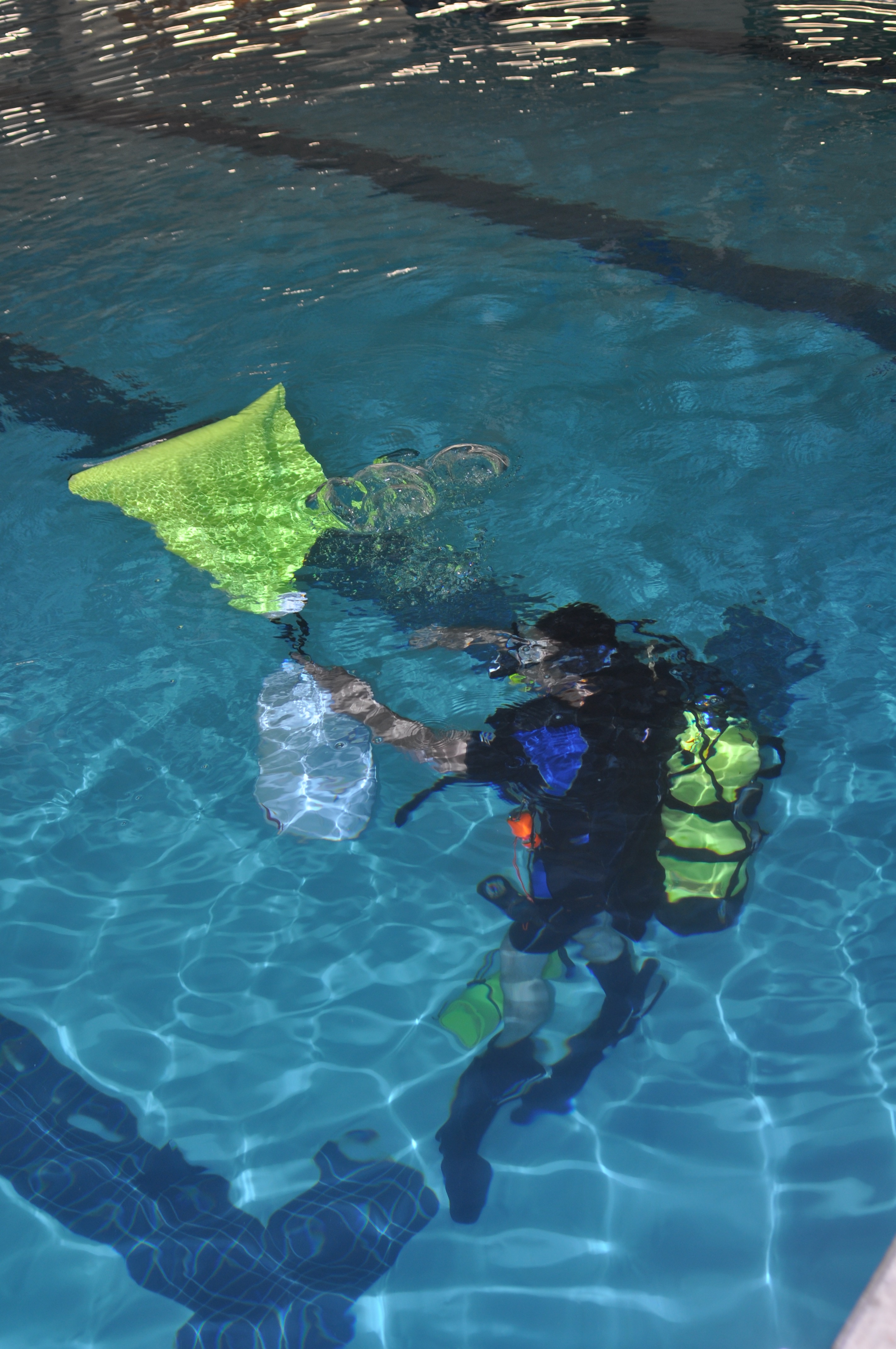
A recovery buoy is attached to the evidence container.
The procedure after finding evidence or a body is to bag it while still in the water. The body bag has fine mesh on side to let the water out, but not the evidence. A design improvement created 6 points of attachment to lift the body bag, allowing more stability during the lift.
For a drowning, the divers buoy the body. For a homicide, the divers wait with a body bag and buoy it. Attaching a buoy allows for easier lifting.
Once out of the water, a record of the chain of custody is kept on the outside of the bag by the Medical Examiner.
Experts say that drowning deaths can be avoided by following some simple rules:
“Ninety percent of our fatalities could be prevented if they were wearing a life jacket (while boating),” North Carolina Wildlife Resources Commission Officer Hannah Shively explained.
If you see someone in distress, try and throw an object towards them, whether it’s a stick, fishing pole, cooler, or life jacket, to pull them to safety. Don’t let yourself or anyone else become a statistic.
*Photos taken by Patti Phillips at two Writers’ Police Academy events in North Carolina. Many thanks to the members of the Guilford County Sheriff’s Department for their informative presentations andto Lee Lofland for organizing the annual events.